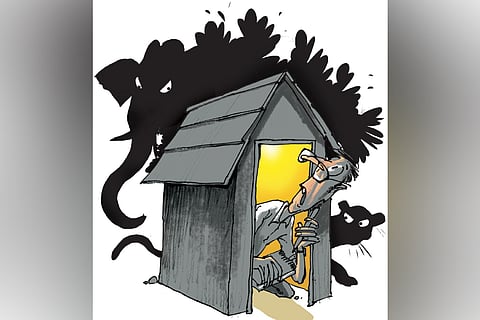

THIRUVANANTHAPURAM: The Congress-led UDF has emerged as the political beneficiary of the socio-political fallout of the rise in human-wildlife conflicts, a burning issue that generated a lot of traction in Kerala’s high ranges in the recent local body polls.
A detailed analysis of the poll data shows that the UDF won 22 of the 30 highly sensitive local bodies that were identified as most prone to human-wildlife conflicts.
Of these, 13 including Sultan Bathery municipality and Aralam panchayat were snatched away from the Left front. The remaining eight panchayats went to the LDF.
The forest department had identified 30 local bodies across the state as prone to human-wildlife conflict, based on the gravity of the situation in each area and the rise in incidents of conflicts.
Of these, nine including two municipalities – Sultan Bathery and Mananthavady, both in Wayanad district – were included in the ‘very high’ category and the remaining 21 in the ‘high’ category. Interestingly, the Opposition front won eight of the nine local bodies in the ‘very high’ category, of which the UDF captured four – Aralam, Panamaram and Thondernad panchayats, besides Sultan Bathery -- from the ruling LDF.
The Congress-led front retained another four -- Mananthavady municipality and Kuttampuzha, Nooolpuzha and Thavinhal panchayats. The LDF could retain only Thirunelly panchayat. In Aralam, which has witnessed constant wild elephant attacks and from where 11 fatalities were reported in recent years, the UDF increased its tally to 13 wards from the previous 8 in 2020. “Issues related to human-animal conflicts were among the crucial topics discussed at the ward-level,” said Joshy Mathew, a former councillor.

Similarly, in the 21 panchayats that figured in the high conflict category, the UDF snatched power from the LDF in nine -- Agali, Kelakam, Kottappady, Kulathupuzha, Payyavooor, Peringammala, Sholayar, Vellamunda and Vengoor. On the other hand, the LDF was able to capture five panchayats – Aryankavu, Chinnakanal, Meenangadi, Poothadi and Pulpally -- from the UDF. Interestingly, though the LDF captured Aryankavu panchayat, it lost Achankovil and Achankovil Kshethram – two wards where human-animal conflicts were reported the most.
“We did do a lot to address animal attacks here. A total of 241 wild boars were shot down. Yet we lost the two wards,” rued CPM leader and ex-councillor Sanu Dharmaraj. Of the remaining, UDF retained Kodassery, Koovappady, Kottiyoor, Mullamkolly and Pindimana, while the LDF retained Ayyampuzha and Kanthalloor.
The Left front came to power promising a permanent solution to issues related to the human-animal conflict. “There were a slew of promises in its manifesto. But in the last 10 years of Left rule, no concrete measures were taken. The resentment in the high ranges reflected in the local body elections. The anger against the government will be more evident during the assembly polls,” said Muslim Lague state president P M A Salam.
Notably, the BJP too has considerably increased its electoral presence in local bodies facing human wildlife conflict.