
MALAPPURAM: Il buono, il brutto, il cattivo... the yellow metal has a way of bringing out the “the good, the bad, and the ugly” in men -- as the 1966 spaghetti western film starring Clint Eastwood so famously captured.
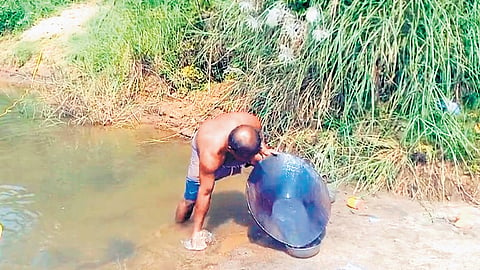
Dig this. The lure of gold has returned to the forests of Nilambur. This time driven by record prices and a new official report. Last week, seven people were caught by the forest department attempting to extract gold from the Chaliyar river, attracting renewed attention to the region’s long and turbulent association with the precious metal. Forest officials said the group, comprising locals, were trying to filter river sand for tiny particles of gold. The attempt, however, was swiftly halted, marking the first such reported case in the area in years.
This renewed interest has been prompted, in part, by the latest Minor Minerals District Survey report, prepared under the state mining and geology department. The report identified a primary gold deposit in the Marutha area of Nilambur basin, along with secondary or alluvial gold occurrences in the Chaliyar and its tributaries. According to the findings, the region holds an estimated 0.55 million tonnes of primary gold-bearing ore, with the mineralised zone stretching nearly 350 metres and extending to a depth of about 100 metres.
The report’s publication -- and its circulation in newspapers and on social media -- appears to have reignited hopes. With gold prices soaring, the belief that “Nilambur still holds gold” has once again taken root among sections of the local population.
But the story of gold in Nilambur is far from recent.
Scars of the past
For centuries, people have tried their luck in the Chaliyar, the lifeline of Nilambur, and its tributaries -- Punnapuzha and Maruthapuzha. As early as the 18th century, the presence of gold reefs in the surrounding hills was widely known, with tribal communities using laborious traditional methods to extract small quantities of gold.
In 1827, a survey by the British administration provided the first scientific confirmation of gold deposits in the Nilgiris and Nilambur regions of Malabar. This discovery set off a wave of exploration across Nilambur, Wayanad and the Nilgiris, eventually leading to the identification of the Nilambur-Wayanad Gold Field -- one of the most ambitious mining prospects of colonial South India.
By the late 19th century, the promise of gold triggered what European newspapers described as the “Malabar Gold Rush” and the “Malabar Gold Mania”. British companies fanned out across Meppadi, Devala, Cherambadi, Pandalur, Munderi, Marutha, Thariyod and Chooralmala, digging shafts into forested hills and washing tonnes of earth in search of profit.
Yet, despite decades of effort, the gold never came in quantities large enough to sustain commercial mining. By 1892, British companies abandoned their ventures, leaving behind scarred hillsides, abandoned pits and shattered fortunes.
What followed were smaller, riskier attempts by former workers and locals, who dug up the soil in forest areas and washed it in rivers, often using mercury -- a practice later banned due to environmental and safety concerns. While tribal communities continued limited extraction for some time, the activity gradually faded into memory. Until now.
The region’s dormant gold narrative has been stirred back to life -- raising fresh questions about enforcement, livelihoods and the uneasy balance between economic desperation and environmental protection.
