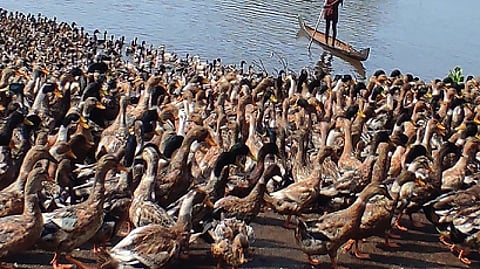

ALAPPUZHA: Kuttanadan duck meat is a delicacy cherished by food lovers for its distinct taste. The unique ecosystem of paddy fields and waterlogged areas in Kuttanad has led to the development of indigenous duck varieties found nowhere else. Through decades of traditional knowledge and research, farmers in the region have developed two rare duck breeds, Chara and Chempally.
In a major boost to duck farmers, the National Bureau of Animal Genetic Resources (NBAGR) under the Indian Council of Agricultural Research (ICAR) has officially recognised the genetic uniqueness of the two breeds. The recognition is significant as duck rearing supports the livelihoods of more than one lakh families in Kuttanad.
Earlier, the NBAGR had recognised Vechoor cow, Malabari goat and Thalassery chicken from the state. The approval is the result of nearly a decade of sustained efforts by farmers and researchers at the Niranam Duck Farm, functioning under the animal husbandry department.
“The development of the Chara and Chempally breeds is the outcome of long-term collaboration between traditional farmers and scientists,” said Dr Thomas Jacob, former assistant director of the farm. “Although farmers in Kuttanad rear several duck varieties, in 2008, the farm authorities decided to scientifically protect Chara and Chempally as these breeds are known for higher egg production and superior meat quality.”
Following the initiative, the farm approached the state government, which approved a project to identify, conserve, and pure-breed the two varieties. With allocated funds and over five years of research, the breeds were developed through conservation of their germplasm.

Pure-bred ducklings were later produced at the farm and distributed to farmers. Subsequently, the Kerala Agricultural University applied for NBAGR recognition, which has now been granted, Dr Jacob added.
Duck rearing remains a crucial supplementary source of income for small farming families in Kuttanad. Most households rear between 10 and 25 ducks in their courtyards and allow them to feed in nearby paddy fields and water bodies, keeping costs minimal.
“A grown duck lays 200 to 220 eggs a year, earning us around Rs 1,800 to Rs 2,000 annually,” said Kuttappan K T, a farmer from Thalavadi. “In addition, duck meat fetches Rs 250 to Rs 350, depending on the weight. A family rearing 25 ducks can earn at least Rs 40,000 a year, which is a vital additional income for most households in our village.”
With the successful production of Chara and Chempally ducklings in government and private hatcheries across central Kerala, duck farming gradually expanded into a large-scale activity. However, recurring outbreaks of bird flu have emerged as a major challenge, said K Samuel, secretary of the Aiyka Tharavu Karshaka Sangam. “During 2010, the duck population in the region ranged between 10 and 20 lakh.
Repeated bird flu outbreaks forced many large-scale farmers to abandon the sector, reducing the population to less than two lakh today,” he said. The NBAGR recognition is a long-overdue acknowledgement of the efforts and investments made by Kuttanad farmers, despite numerous challenges, he added.
Specialities of Chara, Chempally duck varieties
In 4.5 months, the duckling grows up and starts laying eggs
Eggs are large and possess medicinal values
They lay 200 to 220 eggs every year
The average weight of an egg is 60 to 70 grams
Their meat is considered delicious
The average lifespan is five years
High immunity