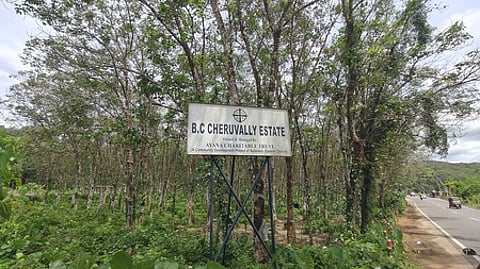

KOTTAYAM: The recent order of the Pala sub-court, dismissing the state government’s claim over Cheruvally Estate, in Erumeli, which is currently in the possession of the Ayana Charitable Society of the Believers Eastern Church, has dealt a major blow to the administration’s efforts to claim ownership of various plantation estates across Kerala.
However, legal experts point out that despite the setback, the order opens up the opportunity for filing an appeal in the High Court.
As per a right to information (RTI) reply from the state special office of the government land resumption wing under the Land Revenue Commissionerate, a total of over 1.66 lakh acres of plantations under the control of various individuals, companies and institutions across the state have been identified for takeover in 11 districts. This includes small plantations exceeding the 15-acre land ceiling limit to large estates owned by companies such as Harrisons Malayalam Ltd (HML), Travancore Rubber and Tea (TR&T) Ltd and others. As of December 31, 2023, the state government had filed 15 cases in various sub-courts, including against Ayana Trust, which holds the 2,263-acre Cheruvally Estate.
These include three in Thiruvananthapuram, six in Kollam, one in Pathanamthitta, and three in Idukki, covering a total of 43,739.76 acres of land. In December 2024, Wayanad district collector filed two separate suits to reclaim 491.72 acres in Nenmeni village, allegedly possessed by HML, and 392.89 acres in Chembra Peak Estate in Muttil South village.
In June 2019, the government issued an order directing 11 district collectors, excluding those from Alappuzha, Kozhikode, and Kannur, to compile a list of landed properties held by HML, its predecessors, or other foreign entities or individuals.
Properties, which were not transferred to current landholders by either the state or central government after independence, were to be identified.
The district collectors were also instructed to initiate legal proceedings on behalf of the government in civil courts within jurisdictions where these lands are located. The objective was to establish government ownership over the entire land. The Cheruvally Estate case was the first of these cases, making its verdict particularly significant.
According to Saji Koduvath, the special government pleader in the Cheruvally Estate case, although the Pala sub-court dismissed the government’s claim to the land, the order leaves the door ajar as it didn’t acknowledge the absolute right of Ayana Trust.
“It is a fact that the civil suit filed by the government has been dismissed. The court could then have come to the conclusion that the title of this property is vested with Ayana Trust. However, the judgment stated that it shall not be construed as a positive or declaratory pronouncement on the absolute or indefeasible title of the defendants (Ayana Trust). We plan to highlight it in the appeal,” he said.
The special pleader also pointed out that since the court did not endorse the title of Ayana Trust, its order is unlikely to reflect upon other properties.