
Cinema connects people in ways that other art forms often cannot. A film can make strangers laugh in unison, feel a multitude of emotions together, and carry home the same questions. It can be a personal and collective experience at the same time.
In Kerala, where love for cinema runs deep, the Cochin Film Society has shown its ability to connect, educate, and inspire, much like cinema itself. For over four decades, the institution has provided an alternative cinematic experience to its loyal audience, while going beyond the mainstream and encouraging viewers to engage with films as art, take part in discourse, and experience cinema as a community.
The Cochin Film Society was launched in 1984 at the humble premises of the Kerala Kalapeedam, a renowned institution started by the pioneers of Kerala’s artistic landscape, such as M K K Nair, C N Sreekandan Nair and M V Devan.
The society was formally inaugurated by the eminent cinematographer Mankada Ravi Varma, with Sergei Eisenstein’s landmark classic Battleship Potemkin chosen as its inaugural screening. Interestingly, in 2025, during IFFK, the same film was briefly barred from screening)

Before its official inauguration, however, the society went through a phase of struggle. Unlike the capital city, Kochi lacked accessible spaces for film screenings. The informal group often had to improvise and rely on the kindness of others. Finding a theatre to screen the films was a constant hurdle. There was not a spot that they did not leave unexplored — from the top floor of the Ernakulam Public Library, the YMCA hall, the old Chavara Centre building, and to the hall inside the Government High Secondary School for Girls.
Once the team selected a venue, the next hurdle was to find a way to project the reels. “We used to get the 16 mm film reels, and there was one person called Kamath who had a projector, and he would lend it to us,” informs Balachandran V A, the secretary of Cochin Film Society.
However, for every screening, they had to look for a venue. Some theatres like the old Ashoka theatre, Kavitha, and Sangeetha, Savitha, Saritha would allow them to hold screenings, but they had to be held at 9am, as the rest of the day was meant for usual commercial cinema,” he adds.
That is when Kerala Kalapeedom stepped up and provided the group a much-needed space.
Another major task was procuring the film reels themselves. Far from the convenience of streaming platforms or YouTube, those were the days when rare films could only be accessed if they were sent from the National Film Archives of India in Pune.
“Cochin University used to get film reels from the archives for their screenings. We would go to the railway station to procure the reels, as they would arrive by train in a heavy trunk all the way from Pune. It was artist T Kaladharan, who was one of the founding members, who guided us in those times,” he recalls.
After the university screens the movie, they would allow the Cochin Film Society to use it for their screening, before sending it back to Pune.
P K Nair, the founder and director of the National Film Archives of India, was also instrumental during this period. “He was the reason why we were able to procure those reels back then. He was aware of our efforts,” says Balachandran, looking back.
“Today, directors sitting in Sri Lanka send us their movies via a Vimeo link,” he says.
Since its inception, the society has adopted an expansive view of cinema. Over the past four decades, it has exhibited more than 3,000 films. All carefully curated to bring the craft, diversity, connection and social relevance of cinema to the forefront. The screenings included classic and modern masterpieces, documentaries and international gems that are often absent from regular theatres.
“We watched many greats during that time, Godard, Kurosawa, and so on. And eventually started organising film appreciation courses and festivals dedicated to filmmakers, genres, or different countries, which we continue to do even today,” he shares.
As popularity grew, the Society had to find ways to conduct its screenings and accommodate larger audiences. “It was around 2005 that we approached the district collector to find a solution. We were then allowed to hold screenings at the newly constructed Children’s Park Theatre. It could accommodate 120 people at a time,” he smiles, looking back. But this too was short-lived, as the theatre was poorly maintained.
Despite the constant hurdles, the society thrived, holding three to four screenings each month, until the pandemic hit. Things slowed down, but the society did not give up. “It was post Covid that we reached out to the Chavara Cultural Centre again. They were extremely supportive and have been associated with us ever since. Credit to the director of the centre, Father Anil Philip. He, being a filmmaker himself, has supported us immensely,” he shares.
The society has caught up to its usual rhythm, post-Covid, slowly but surely. A milestone in this revival was their successful screening of P Bhaskaran and Ramu Kariat’s masterpiece ‘Neelakuyil’.
Most screenings are followed by open discussions, taking movie watching a step further and making it a collective experience. Something that cannot be replicated while watching a film alone on a streaming platform. “We invite speakers for these discussions — filmmakers, social commentators, or cultural experts connected to the film,” Balachandran explains.
The audience has also changed, they are now multi-generational — students to retired cinephiles, young filmmakers, and curious newcomers.
Former secretary Anoop Varma, who arrived in Kochi in 2000, had heard about the society’s activities even from afar, especially the workshops, festivals and courses it used to conduct. According to him, one should know film theory to be able to understand and enjoy classical cinema. “The Cochin Film Society makes sure to impart this much-needed knowledge among film lovers.”
It continues even now. Recently, the society organised a script-writing workshop taught by C S Jayaram. “It had a great turnout. We also screened ‘Papa Buka’ by Dr Biju, the official entry from Papua New Guinea for the Oscars,” adds the former secretary.
And all in an age of individual screens and isolated viewing. This is where the relevance of such societies still lies — bringing people together, connecting them over a dialogue, a scene, background music, or a script— in the spirit of cinema.
Milestones
1984- Officially inaugurated at Kerala Kalapeedom by cinematographer Mankada Ravi Varma with the screening of Battleship Potemkin
1989- First film appreciation course conducted
2004- Organised the Cochin International Film Festival
2012- First Cinematography workshop
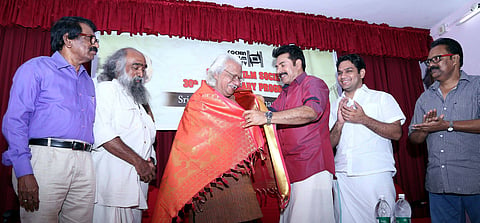
2015- Retrospective of Films by Adoor Gopalakrishnan, inaugurated by Mammootty
2016 Kannada Film Festival
2018 Gabriel Garcia Film Festival
2025- Conducts the first-ever screening of the remastered version of ‘Neelakuyil’
Upcoming event
‘Revisiting legendary directors — A talk series’ will be held on February 3 at Chavara Cultural Centre. The series will begin with the screening of Ingmar Bergman’s ‘Wild Strawberries’, and followed by a discussion.
Membership fee
Annual membership: Rs 800 (single member)
5 Year Membership: Rs 3500 (single member)
For details about becoming a member: 94963 34492