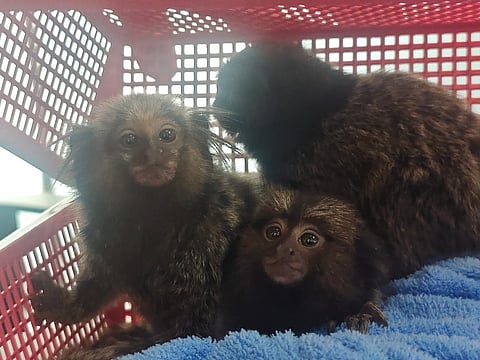

KOCHI: At first glance, it may appear a harmless fascination -- a rare bird perched in a private aviary, a turtle plodding its way silently inside a glass tank, a snake curled up within a temperature-controlled enclosure.
But behind Kerala’s growing appetite for exotic pets lies a shadowy, well-organised network of smugglers, middlemen and discreet buyers, operating across borders and thriving in legal grey zones.
An investigation by TNIE reveals that species such as the magnificent bird-of-paradise, king bird-of-paradise, maleo, Visayan hornbill, and hyacinth macaw are among the most sought-after birds in the state’s underground pet market. Demand is equally high for non-avian species such as red-eared slider turtles, Chinese pond turtles, and ball pythons, and exotic lizards, with prices ranging from a few lakhs to staggering sums.
Smuggling routes & airport busts
Most of these exotic species are smuggled to Kerala primarily through Thailand and Malaysia, concealed inside passenger baggage and routed via international airports. Kochi has emerged as a key interception point.
Customs officials confirmed that in 2024, at least 14 exotic birds were seized, while 2025 witnessed two major smuggling attempts, including one involving a bird valued at nearly `1 crore in the illegal pet market.
A senior officer explained how live consignments are identified. “An unusual orange colour on the baggage scanner usually indicates the presence of live species or organic material,” the officer said.
Heightened vigilance at Kochi airport has forced several rackets to temporarily avoid the chief route.
However, officials admit this has only diverted the trade, not dismantled it.

Demand despite crackdowns
TNIE found that many exotic species now make their way into Kerala through Tamil Nadu and Andhra Pradesh, bypassing direct international scrutiny. Once inside India, the animals are transported discreetly through road networks.
To understand the demand, this correspondent approached pet sellers in Kochi. One dealer, Kumar (name changed), initially claimed that turtles are kept for luck, while snake-like ball python are sought after by black-magic and occult groups. When approached under the pretext of escaping bad luck, Kumar suggested turtle species. When pressed about snakes, he turned cautious. “Honestly, I don’t know what happens after delivery. It’s a closed group. I just supply based on orders,” he said.
Kumar also revealed that demand exists across the state. “There are buyers throughout Kerala,” he said. “People initiate contact through references. Some want birds, some turtles, some snakes. It’s not just city-based anymore.”
Network guarded by trust
Further investigation revealed that traders dealing in exotic species operate through tight, reference-based networks, carefully verifying buyers. Another dealer, John (name changed), reluctantly shared details of the operations.
“There are multiple WhatsApp and Telegram groups,” he said. “You can’t just walk in. You need a reference.” According to John, animals are sedated for long journeys, and high-value transactions require 60% advance payment. “If a bird worth `1 crore has to reach Kochi, advance is mandatory,” he said. “If it dies during transit, another one will be arranged.”
Prestige & perils
Interactions with exotic pet enthusiasts revealed mixed motivations. Some claim genuine affection for rare species, while others see ownership as a status symbol.
What remains unanswered -- and deeply worrying -- is what happens when owners abandon these animals.
In 2024, this correspondent filed an RTI query seeking details on whether the ministry of environment, forest and climate change tracks those keeping non-native species and the steps taken to prevent abandoned exotics from threatening native wildlife.
The ministry’s response was brief: “The ministry has notified rules for registration of possession, transfer, etc., of CITES-listed exotic species.”
On sharing this reply and the current situation in Kerala, a senior ministry official was, however, candid off the record. “Is it practical to conduct raids in every house in the country for exotic species? How do we stop someone from releasing a ball python into the wild? He may release it at some isolated place. That is the real challenge.”
Legal hurdles, enforcement risks
Officials with the Wildlife Crime Control Bureau (WCCB) tracking such cases admitted the scale of the problem. “This is a big racket,” a WCCB official said.
“There are illegal hatcheries operating in Thailand, producing turtles like the red-eared slider and snakes like the ball python. Their networks are already under investigation.” Customs officials face serious personal and legal risks during interceptions.
“When we open a suspicious bag, we don’t know what we will find. Imagine encountering a poisonous snake,” a customs officer said. “So far, we have been fortunate.”
Under the Wildlife (Protection) Act, 1972, and CITES (Convention on International Trade in Endangered Species of Wild Fauna and Flora), offenders are arrested, and seized animals are repatriated to the country of origin at the passenger’s expense. Passenger details are also flagged in the Airport Passenger Information System (APIS) to alert customs authorities nationwide.
Joining The Dots
Expensive bust: An exotic bird, valued at nearly C1 crore in the illegal pet market, intercepted in Kochi
Smuggling hotspots: Thailand and Malaysia remain primary source countries; routes now shift via neighbouring Indian states
Occult demand: Pythons are reportedly sought after by black-magic and occult groups
Digital syndicates: WhatsApp and Telegram groups control access to high-value exotic species
Ecological threat: Abandoned non-native species pose serious risks, with no clear system to track or prevent releases