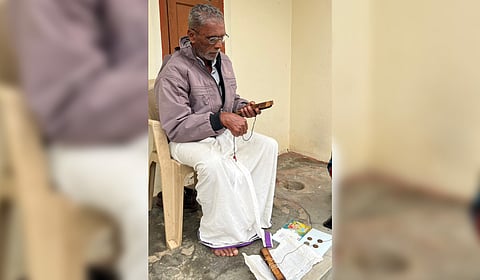

IDUKKI: In an age dominated by hospitals and prescriptions, a wooden trunk containing palm leaves kept inside a modest house in Idukki’s Keezhanthoor stands as a quiet reminder of a fading medical tradition. Preserved by 76-year-old T S Gunasekharan, the manuscripts document ancient herbal practices once relied upon by hill communities across Anchunadu.
The language is a mix of ancient Tamil and Sanskrit, yet Gunasekharan reads them with ease, decoding remedies recorded generations ago. And, when villagers approach him for guidance, mostly related to animal health, he refers to the palm leaves and hands them the herbs mentioned.
Gunasekharan inherited the knowledge from his father Subramanian, a well-known herbal practitioner in the region. “I began engaging seriously with this knowledge from age 45. Earlier, people depended almost entirely on herbal remedies for issues like snake bites, jaundice and Vata-related disorders; they believed it was highly effective. The reliance on herbal medicines gradually declined with the advent of modern medicine and hospitals,” Gunasekharan told TNIE. Today, such traditional practices are largely limited to animals, he said.
Anchunadu is an agrarian region where farming is the primary livelihood. Gunasekharan said the ailments affecting cattle, horses and pet animals are frequent and can directly impact the agricultural activity. “If animals fall sick, farming suffers. That is why people still seek traditional herbal solutions,” he said.
The manuscripts list a range of medicinal ingredients, including Kadukkai (Chebulic myrobalan), Kodikalli (Euphorbia tirucalli), Pirandai (Cissus quadrangularis), Karinjali (Acacia catechu), honey and Thuthuvalai (Solanum trilobatum). These herbs are sourced from nearby forests. However, Gunasekharan said restrictions have made collection difficult. “Now, the herbs are gathered only during emergencies,” he said.
Determined to preserve the knowledge, Gunasekharan regularly rewrites the manuscripts on fresh palm leaves using an ezhuthani (stylus) to prevent deterioration. A farmer, he admits the tradition may end with him.
“The younger generation is not interested in it. My son Ramesh does not know how to read the manuscripts. People prefer allopathy today,” he said.
Still, Gunasekharan continues to safeguard the palm leaves. “And as one of the last keepers of this knowledge, I will preserve it for as long as I can,” he said.
