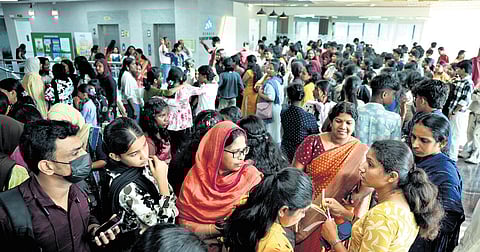

KOCHI: At first glance, the Liora Innovation Conclave looks like a giant children’s science fair.
And why wouldn’t it? The state-level event, organised by Kudumbashree’s child collective Balasabha, is a gala of ideas and brings together projects developed by over four lakh children from more than 30,000 neighbourhood sabhas across Kerala.
But linger a little longer, and it becomes clear that the conclave is “not just about display”. “It is the endpoint of a slow, structured process that encourages children to notice problems around them and attempt solutions,” said Kudumbashree executive director H Dineshan. “The aim,” he highlighted, “is to nurture problem-solving at the grassroots.”
That ambition is visible in the projects. Many of them are responses to problems that children encounter daily. And they cut across agriculture, climate resilience, digital technology, culture and public health.
For Daivik Menon, who hails from Eloor in Ernakulam, the trigger was just outside his house — a polluted Periyar river. “I’ve built a small floating island that can be placed in polluted water bodies. It uses plants and natural processes to absorb pollution over time, instead of adding chemicals to the water,” the 10th grader explained. Equally important, Daivik said, was the space Balasabha gave him to pursue the idea. A member for two years and now the local president, he credits the collective for pushing him to speak up and engage with public issues.
Reja Mariyam, another 10th grader from Malappuram, echoed a similar view. “Balasabha also helps you turn your ideas into reality,” she said, adding, “It’s a big collaborative platform.”
Her project, CocoDrone, looks at coconut harvesting. “Labour in this field is scarce, and climbing trees is dangerous. So I have got a drone carrying a small robot to the top of the tree. The robot does the cutting. In addition, cameras also check whether the coconuts are ripe and spot signs of diseases.
This way, farmers get more information,” Reja explained. K S Anandhu’s project tackles what he sees as the biggest bottleneck in effective waste management – plastic collection. His Eco Reward ATM rewards people for depositing plastic waste. “This way, people are encouraged to participate instead of avoiding it.”
Much like his project, Anandhu, who hails from Mavoor, Kozhikode, said Balasabha helped him move past his shyness and engage with public issues.
Anamika N’s project looks at replacing plastic with a more sustainable material derived from wood. “When lignin is removed, wood becomes transparent and flexible. It can then be shaped and used instead of plastic,” she explained. “The idea is to reduce plastic use by creating an eco-friendly alternative that can be adapted for different applications,” said the youngster, who hails from Malappuram.
Alappuzha-based Surya Gayathri’s project is a mental well-being website, inspired by the Buddhist idea of Samatha. “Students can reach out through chat or call and can have their issues heard by professionals. In this age of drug menace, I think a safe space to talk is essential,” she explained.
Strikingly, what she said next summarised the extent of the Kudumbashree child collective’s impact. “We are children, yes. But we too have ideas to solve complex issues. At Balasabha, all ideas are taken seriously,” Surya added.
Muktha V K spoke about human-wildlife conflict, a problem she said has become routine in forest fringes. Her project, eKomban, is a wildlife tracking rover designed to reduce dangerous encounters without harming animals.“The rover tracks animal movement near villages and roads and sends alerts to forest officials,” she explained. “The idea is to detect animals early and gently guide them back into the forest.”
The projects on display also ranged from farm tourism in Wayanad and millet-based food products to vertical wind turbines for small urban spaces, rainwater harvesting systems, digital folk-song archives and simple public health innovations.
Students repeatedly pointed to Balasabha’s support system as central to their journey. Mentoring, they said, came from organisations such as the Udhyam Learning Foundation, TinkerSpace, alongside academics, professionals and local officials.