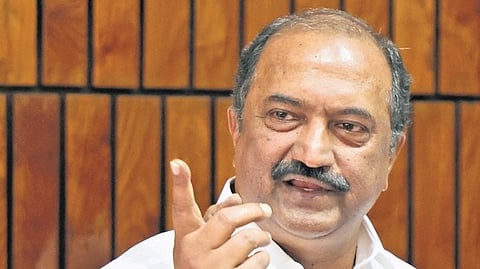

Finance Minister K N Balagopal’s departing budget speech was far too long to bear even for the most patient, I suppose. Of course, he is not the only finance minister to inflict such a long-winded speech. He spoke in so much detail about the allocations to different schemes, both existing and proposed. The actual implementation of all that he proposed depends crucially on whether the LDF will come back to power or not. Therefore, let us keep our bets closely to ourselves until the election results are out.
The finance minister was keen on giving an average picture of his performance for the last five years instead of giving an annual account, as is usually the case. I am therefore picking on two crucial aspects of the budget performance for the last five years say, LDF 2, and comparing it with the earlier five years i.e., the LDF 1.
It is attractive for a finance minister to say that he made considerable progress in collecting revenue by showing the additional tax revenue of Rs 1,27,747 crore figures in absolute terms. He said he increased the average annual own tax revenue from Rs 47,453 crore during LDF 1 to Rs 73,002 crore during LDF 2. Obviously, he did not seem to bother about adjusting the figures for inflation to show the real growth.
But, more seriously, is this a measure of increase in revenue collection efficiency? Certainly not. Because a direct and easy to understand measure of revenue collection (tax and non-tax) efficiency is the ratio of revenue collected to the income of the state.
During LDF 1, Dr Thomas Isaac managed to collect 8% of the state domestic income i.e., for every 100 rupees of income generated in the state, he collected 8 rupees. During the next five years of LDF 2, Minister Balagopal managed to collect just 7.7. Remember, 2020-21 was a Covid year and the whole country and all states experienced a decline in their annual income. Therefore, it is only fair to compare the first four years of Dr Isaac with that of Balagopal.
Then the figures work out to 8.2 and 7.7. In this crucial task of revenue collection, Dr Isaac comes out better than Balagopal. I had criticised Dr Isaac for the low ratio in revenue collection compared to the earlier years. It was 11 to 12%in the early 1980s, 10% in the 1990s and then around 9% till 2004. After that it came down to 8% and the new normal is below 8% in a flourishing private economy with increasing remittances and its multiplier effects. Remember, Kerala tops the list of major states in per capita consumption for the last three decades!
My other focus is on the burden of interest and pension payments from the total revenue (Own revenue plus central transfers). During LDF 1, the five-year average for pension payments as a percentage of total revenue works out to 21.3 and interest payment works out to 19.2. That is to say, only 59.5 rupees from every 100 rupee of government revenue were available for meeting government expenditure.
This increased to 22% for pension payments and 21.4 for interest payments during LDF 2. That is a total 43.4% leaving the government only 56.6 rupees from every 100 rupee of its income. Here again, Dr Isaac shines in comparison. Kerala’s debt and pension burdens are a long-term one. For all states in India combined it is around 20-21% i.e., just half the burden of Kerala. There are no quick fixes short of a strong political will to collect revenues that are due and to reform the pitiably low retirement age.
