
KOCHI: With a weak monsoon sending both mercury and power consumption soaring, the KSEB is scrambling to meet a shortage of power during peak hours.
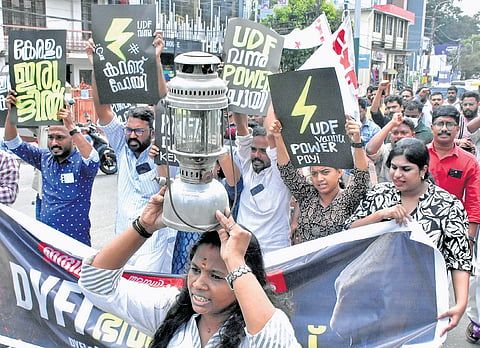
Complaints have been pouring in at KSEB offices regarding multiple outages during night hours and opposition parties have launched protests against power regulations. KSEB chairman M G Rajamanickam said there is a shortage of 500 MW during peak hours and the board is not in a position to withdraw the regulation as internal generation remains low and national exchange faces acute power shortage.
The KSEB has been imposing power regulation across the state from 7 pm to 2 am. The board has only 28% storage in its dams, which is sufficient to generate only 1,175 million units of power. The daily generation, which stood at 17.23 MU on Tuesday, was raised to 26.33 MU on Thursday. However, the consumption that stood at 75 MU on July 5 rose to 91.78 MU by Thursday. The board imported 65.45 MU on Thursday but is struggling to bridge the gap between available power and demand due to the non-availability of power in the national exchange.
“The demand for power has risen across the country due to a deficit monsoon. The processing of tender for the purchase of 200 MW power for one year, from July, is in the final stage.
The agreement will be finalised after obtaining permission from the Power Regulatory Commission. Another tender for the purchase of 500 MW during peak hour and 200 MW round the clock from September is being processed,” Rajamanickam said.
The board has signed an agreement for the purchase of 200 MW power during daytime and 100 MW for four hours during peak time, which will be available from April, 2028.
A tender has been invited for the purchase of 300 MW for three years during peak hours from 6 pm to midnight. The KSEB has approached the Power Regulatory Commission for some changes to the guidelines. If the commission approves, the board will get 300 MW power from January 1, 2027.
Refuting allegations that the change of government has derailed the process to ensure power availability, a KSEB official said the board had started tender proceedings on May 7, 2026, for the purchase of power for six months from June to December. The India Meteorological Department (IMD) alert about El Nino was issued on June 12. The KSEB started preparations to meet the power shortage immediately after the alert was issued. As many as four tenders were floated between May 7 and July 7.
Accepting that the decision to cancel the agreement signed in 2014 to purchase 465 MU power has aggravated the crisis, the KSEB official said that deal would have helped the state avert power regulations at this juncture.
“The state is forced to impose power regulation as there is a shortage of 500 MW during peak hours. The KSEB had invited two long-term and three mid-term tenders for power purchase to bridge the shortage but we could not finalise the tender as the rates were exorbitant,” he said.
Though the KSEB is purchasing additional power at an exorbitant rate of Rs 9.16 per unit, there is no threat of revising the power tariff as the volume of power purchased from the real-time market is comparatively negligible. But if the monsoon fails and internal generation at hydel projects is affected, the state will be forced to depend on additional power purchase. That may lead to an increase in power tariff.
PUMPED STORAGE TO INCREASE GENERATION
To reduce dependence on power purchase, KSEB has planned to implement four pumped storage projects with a capacity to generate 2,000 MW. It is in the process of preparing a DPR for the 800MW Kakkayam project, 400MW Poringalkuthu project, 100MW Muthirapuzha project and 700MW Idukki project. These are linked to existing hydel projects. KSEB is also exploring the possibility of establishing three pumped storage projects — the 1500MW Upper Chaliyar project, 750MW Sabarigiri project and 750MW Poothampara project.
Power shortage
July 16
Consumption: 91.78 MU
Internal generation: 26.33 MU
Import: 65.45 MU
July 15
Consumption: 90.45 MU
Internal generation: 21.02 MU
Import: 69.43 MU
July 14
Consumption: 88.60 MU
Generation: 17.23 MU
Import: 71.37 MU
