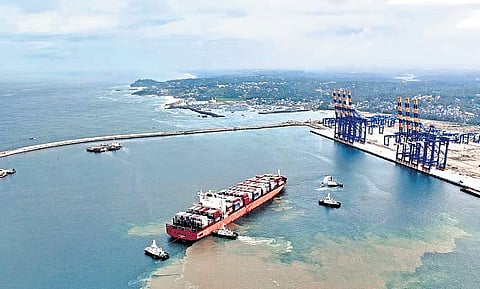

THIRUVANANTHAPURAM: With less than a month to the opening of the export-import (exim) facility at Vizhinjam International Seaport, experts are tempering expectations. On August 18, Chief Minister V D Satheesan will flag off the first export container on the sidelines of the ‘Mission Samudra’ business summit, even as critical road and rail connectivity deficit threatens to impact gateway cargo growth.
Though the transshipment business has been flourishing, severe delays in developing the domestic cargo ecosystem remain a major concern.
Former shipping secretary K Mohandas highlighted the core demand problem. “The biggest drawback for Vizhinjam is that there is hardly any gateway cargo in south Kerala. Will there be any cargo for export or import? That is the biggest question.”
However, he remains hopeful that the flourishing transshipment business, driven by Mediterranean Shipping Co (MSC)’s investment, will eventually trigger the growth of local export-oriented industries.
For now, progress on the critical 80km Thiruvananthapuram Outer Ring Road (NH 866), meant to connect the port to Navaikulam, leaves much to be desired. Road and rail connectivity, too, would take more time, prompting port officials to confirm that the immediate focus will remain heavily balanced in favour of transshipment.
Exporters also remain wary of the sluggish pace of secondary developments. “The pace of developing the infrastructure necessary for gateway cargo handling has been extremely slow. Unless there are facilities for container storage, exporters will be reluctant to utilise the land facility,” a ports department official said.
Perishable sectors such as agriculture and seafood, along with electronics, require rapid turnaround times that current facilities cannot support. “Perishable products require reefer (refrigerated) containers. There should be space to keep these containers refrigerated till they are cleared for loading. There are not even enough fuel stations to accommodate the container trailers,” the official added, noting that government land acquisition delays have inflated local real estate prices.
Compounding Kerala’s domestic hurdles is a swift competitive challenge from neighbouring regions. Tamil Nadu has already proactively provided land for auxiliary industries, positioning its industrial hubs to capitalise on Vizhinjam’s deep-water capabilities much faster than local markets.
Experts warn that without immediate intervention to scale up multimodal rail-road connectivity and build a robust domestic manufacturing base within the state, the anticipated exim facility faces severe underutilisation, leaving the port reliant on transshipment while neighbouring states reap the economic rewards.
