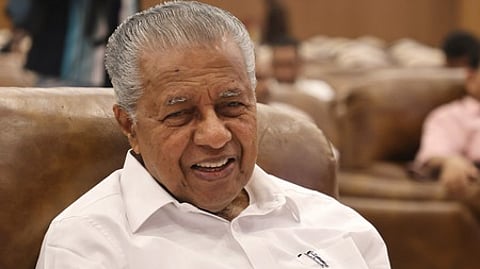

The CPI(M) has acknowledged that its campaign for the 2026 Kerala Assembly elections became overly focused on then Chief Minister Pinarayi Vijayan, allowing the Opposition to turn the contest into a personal battle rather than a political one.
The admission is contained in the party’s Review of Assembly Election Results, adopted at the Central Committee meeting held from 11 to 13 July 2026 after discussions within the Kerala state secretariat and state committee.
The review said a perception had emerged that the entire campaign revolved around a single individual.
While noting that politburo member Vijayan had led the government effectively, the document said the party had inadvertently enabled the Congress-led United Democratic Front (UDF) to target him by personalising the campaign.
“By personalising the campaign and centring it around Com. Pinarayi Vijayan, we unwittingly gave an opportunity to the UDF to conduct a targeted campaign against him,” the review said.
It added that this resulted in the CPI(M) losing the political initiative to expose what it described as the Congress party’s and the UDF’s “reactionary, ruling class bias”.
The review also cited inadequate coordination between the party and the government as a factor behind the Left Democratic Front’s (LDF) defeat. It recalled that previous Left governments had established sub-committees to monitor the implementation of government schemes and cabinet committees to guide ministers, ensuring closer coordination between the party and the administration.
According to the document, these mechanisms helped minimise mistakes and prevented both allies and opponents from questioning the party’s political positions.
The review identified political, administrative and organisational shortcomings behind the electoral setback. While the campaign highlighted the achievements of the LDF government, it failed to adequately explain the constraints imposed by India’s federal structure, the report said.
It also acknowledged that the campaign created an impression that the government could address every issue facing the public.
The party further admitted that its emphasis on development and welfare was not matched by a sufficiently strong political campaign against neoliberal economic policies and what it described as corporate-communal politics.
The review said the CPI(M) also failed to effectively counter allegations by the Congress-led UDF, the Indian Union Muslim League and Jamaat-e-Islami that it had a tacit understanding with the BJP.
It acknowledged that a CPI(M) minister reading out a message from Uttar Pradesh Chief Minister Yogi Adityanath at the Global Ayyappa Sangamam had damaged the party’s secular image.
Describing the incident as “a major embarrassment”, the review said it created the impression that the party was soft on Hindutva forces.
The document also admitted that the party’s response to anti-Muslim remarks by Vellappally Natesan was inadequate and that comments made by some leaders alienated sections of the public.
It noted that the controversy over PM-SHRI schools and differences with CPI, an LDF ally, were used by the UDF to reinforce allegations of a BJP-CPI(M) understanding. The review stressed that all LDF partners should be consulted on such issues to avoid similar controversies.
The party also criticised the public communication of some of its leaders, saying avoidable remarks were exploited by political opponents and sections of the media to damage its image. It called for shorter, sharper and more politically focused public speeches.
The CPI(M) further acknowledged that sections of its traditional support base, including workers, agricultural labourers and poor farmers, did not vote for the Left in the election.
Although the government had opposed the four Labour Codes and introduced several pro-worker measures, these achievements were not communicated effectively during the campaign, the review said.
The assessment comes after one of the LDF’s worst electoral performances in Kerala. In the 2026 Assembly elections, the alliance won just 35 of the 140 seats, while the Congress-led UDF secured a decisive victory with 102 seats. The BJP also opened its account in the state Assembly by winning three seats, Chathannoor, Kazhakkoottam and Nemom.
(With inputs from PTI)
