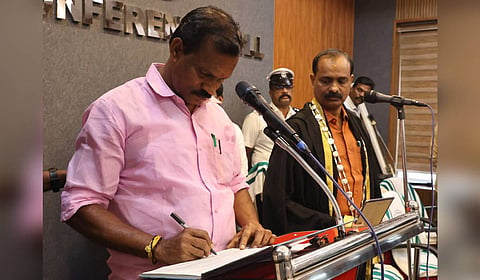

KOCHI: Nineteen BJP councillors in the Thiruvananthapuram corporation were sworn in again on Wednesday after the Kerala High Court invalidated their earlier oath-taking in the names of various deities and martyrs, holding that it did not conform to the prescribed legal form.
The BJP councillors took the oath afresh in the name of God at the corporation office in the evening. However, neither of the opposition fronts attended the ceremony held in a hurry. They alleged that the function was held without informing the opposition councillors and in a “secretive manner”.
Though the court invalidated the oath-taking of 20 councillors, one could not participate in Wednesday’s ceremony as he is currently in prison in connection with a KAAPA case.
Earlier, allowing a writ petition, Justice P V Kunhikrishnan held that an oath cannot be altered to include references to political parties, their leaders or martyrs. The petition, filed by leader of opposition in the corporation, S P Deepak (CPM), had challenged the oaths taken by the 20 BJP councillors, stating that Section 143 of the Kerala Municipality Act permits elected representatives only to take oath in the name of God or make a solemn affirmation.
The councillors had invoked names, including Sree Padmanabha Swamy, Attukal Amma, Ayyappa, Bharathamba and others. Some members had also invoked martyrs associated with their political organisation. The court observed that when the statute prescribes a specific form — either in the name of God or by solemn affirmation — the term “God” cannot be expanded by naming particular deities, leaders or martyrs.
‘Oppn councillors were not informed about swearing-in ceremony’
The court noted that the word “God” has not been specifically defined under either the Kerala Panchayat Raj Act or the Kerala Municipality Act. It also directed the State Election Commission to make arrangements for the councillors to take the oath afresh within four weeks.
The High Court also invalidated the oath taken by a ward member of the Vadakkanchery grama panchayat in the name of former chief minister Oommen Chandy. The member has been given four weeks to take the oath afresh in accordance with the law.
The court said the councillors had taken the oath under a bona fide belief that it was legally valid.
Since the illegality was declared only through the judgment, no penalty could be imposed on them under Section 512 of the Kerala Municipality Act or Section 258 of the Kerala Panchayat Raj Act, which provides for fines where a person knowingly acts as a councillor or member despite being ineligible to hold office.
Observing that the councillors had been elected through a democratic process, the court said their election could not be set aside merely because of an illegality during the oath-taking ceremony.
The decisions and actions taken by the councillors so far would remain valid, the court clarified, adding that such protection is available under Section 531 of the Kerala Municipality Act, which provides that a council’s decisions cannot be invalidated merely because of a defect or irregularity in the election of a member.
However, the court noted that there is no corresponding provision in the Kerala Panchayat Raj Act. It consequently held that all actions taken so far by the Vadakkanchery panchayat member, whose oath was declared invalid, are invalid.
Raising concerns over the manner in which the ceremony was conducted, Deepak said the court had allowed sufficient time for the process to be completed.
“Opposition councillors, including me, were not informed about the event, and many came to know about it only through media reports shortly before the event began. A council meeting was already scheduled for June 29, and the oath-taking could have been held then in the presence of all councillors,” said Deepak.
He said the BJP administration didn’t inform LSGD principal secretary, who is the appellate authority in the matter.
The UDF alleged that the oath-taking ceremony was conducted in a secretive manner without following proper democratic procedures.
“The oath-taking was carried out ‘through the back door’ without informing other councillors or consulting the state government,” UDF parliamentary party leader K S Sabarinadhan said in a statement.fbha
