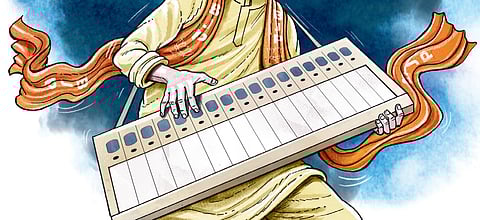

THIRUVANANTHAPURAM: Nemom is not merely another constituency under scrutiny. It is a battleground layered with memory and meaning. In 2016, this seat in Thiruvananthapuram rewrote Kerala’s political script when the BJP’s lotus bloomed here for the first time. The victory cracked the state’s entrenched bipolar order and handed the saffron party its maiden Assembly foothold.
But the breakthrough was short-lived. Five years later, Nemom slipped away and with it, the BJP’s lone presence in the House. Now, the stage is reset. The BJP wants redemption on what it considers its most fertile ground in Kerala. The LDF and the UDF are equally determined to ensure that history does not repeat itself. Nemom, once again, is less about arithmetic and more about assertion. It’s a contest where symbolism weighs as heavily as numbers.
For decades, Nemom alternated between the LDF and the UDF. The 2008 delimitation transformed it into a fully urban constituency, altering its electoral chemistry. In the first election in its present form in 2011, BJP veteran O Rajagopal multiplied the party’s vote share five-fold, though CPM’s V Sivankutty emerged victorious. By 2014, Rajagopal had signalled the shift. Contesting the Thiruvananthapuram Lok Sabha seat, he topped the Nemom Assembly segment, stunning observers.
Two years later, he defeated Sivankutty in Nemom and became the BJP’s first MLA in Kerala.The pendulum swung back in 2021. Sivankutty reclaimed the seat, defeating BJP heavyweight Kummanam Rajasekharan by 3,949 votes. K Muraleedharan’s entry from the UDF camp turned the contest triangular yet sharply polarised. It blunted the BJP’s attempt to frame Nemom as a straight saffron-versus-Left duel.
The 2024 Lok Sabha election added another layer. BJP leader Rajeev Chandrasekhar delivered the party’s strongest-ever performance in an Assembly segment in the state, polling over 61,000 votes in Nemom and securing a margin exceeding 22,000 over Shashi Tharoor. The momentum appeared to carry into the 2025 local body polls, where the BJP captured 17 of the 22 Corporation wards within the constituency.
Demographically, Nemom remains finely balanced. A predominant Nair population coexists with roughly 15 per cent Muslim voters who are often decisive in close contests. The constituency also has sizable Ezhava, Christian and Nadar voters. Sivankutty’s 2021 win is widely attributed to a consolidation of Muslim votes aimed at preventing a BJP repeat. Muraleedharan, meanwhile, reclaimed upper-caste Hindu votes for the UDF that had drifted towards the BJP in previous cycles.
This time, the BJP camp exudes confidence, with state chief Rajeev Chandrasekhar informally emerging as its likely face. Party insiders believe his national profile, proximity to the Modi government and a perceived anti-incumbency undercurrent could tilt the scales.
The UDF, sensing the stakes, knows it cannot afford to drift. With Muraleedharan reportedly eyeing neighbouring Vattiyoorkavu, Congress leaders recognise that only a heavyweight candidate can prevent Hindu votes from gravitating back to the BJP.
For the LDF, Nemom is not just another constituency. It is a battlefield of pride and proof. It is both a line of defence and a bold declaration of intent. Even though Sivankutty has expressed reluctance about re-entering the fray, the CPM’s strategic decision to field all sitting MLAs in Thiruvananthapuram signals that his candidature is all but sealed. The Left is poised to present Sivankutty as the leader who “closed the BJP’s account” in Kerala. In Nemom, the battle lines are familiar but the stakes feel sharper. This is no routine electoral skirmish. It is a referendum on momentum, memory and the limits of Kerala’s political duopoly.