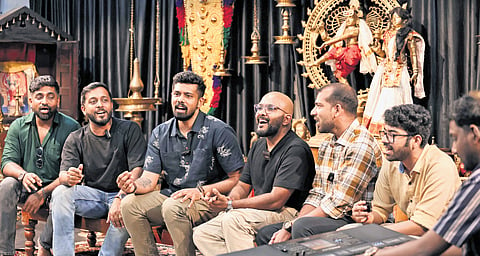

Music becomes an emotion when they sing. The story of Nandagovindam, ‘a trendsetter bhajan band’, is 25 years old. They started out as a bunch of young boys who loved to sing bhajans, in Kottayam. Their mentor, Rajendra Panicker, blind yet with a vision, brought them together and bound them with the notes of music.
Newcomers have entered, adding lustre to the team. Together, they command a star value that at times surpasses that of even superstars, attracting crowds of thousands for their programmes and adding to the growing interest for bhajan among young and old alike. TNIE spoke to them about their journey so far and ahead.
Excerpts
Yur bhajans troupe has become a star attraction. Can you take us through the journey of Nandagovindam Bhajans over the years?
Struggles were there in the past, and they are still there. We reached here because of our love for bhajans and music, and of course, the friendship among us. The happiness we get out of it is beyond money. Be it our travel or sleeplessness or office-work balance, the happiness of doing what we love keeps us together.
How many people were there initially?
Naveen has been here from the initial phase, for the past 25 years. There are people who joined us 13 to 18 years ago and even those who joined while in Class 3. Some members have rejoined too.
It was rare to see youngsters singing bhajans, especially in Kerala…
We were connected to the temples nearby, where we would hear bhajans and attend saptahams. Gradually, we developed an interest towards this, and it made us happy. Ultimately, art aims to provide happiness to people. Also, the fact that our families had given us the freedom to choose what we liked helped us.
At what age did you begin?
We were, maybe, in Class 8 or 9. There were many youngsters who came into this bhajans group at the time. Only those who imbibe it can perform well. There were many instances of people being sceptical about our performances, about our potential lack of interest in studies.
Most of your contemporaries might have thought of reaching the film music industry as their final goal. Didn’t you have any such interest?
Not really. Rather, we were thinking of how to bring film music into bhajans. Apart from liking film songs and having our favourite musicians there, none of us was ever interested in going into that field of music. Bhajans were always close to our hearts, and we focused on spreading these bhajans and growing through them.
Are you all trained in classical music?
Some of us have learnt it, while others haven’t.
In your early days, were you keen to stick to the ‘Sampradaya Bhajans’ or did you improvise on the same?
Improvisations mostly came later. We follow the ‘Devatha Dhyanam’ format of ‘Sampradaya Bhajans’, but we are never completely stuck to it. Our audience was also not really interested in ‘Sampradaya Bhajans’. We haven’t performed ‘Radha Kalyanam’ or ‘Rukmini Kalyanam’, which is mostly done by Tamil Brahmins, after studying the rules. We just take the essence of bhajans from them. But we do listen to their performances. It was in one of our Mumbai tours that we introduced ‘Manohari Radhe Radhe’ along with ‘Rukmini Swayamvaram’ into our performance. Slowly, people started enjoying it. The audience will be engaged only if you offer them something new.
Was this your first hit song?
In terms of social media acceptance, yes.
Can you recall the time when you had fewer listeners?
(Laughing out) Happened a lot, in fact. But that was never a problem for us. We thoroughly enjoyed what we were doing.
Aren’t you all working professionals? How do you manage this with your work?
Yes. Some have quit their jobs, and some more will quit soon. Time management is all about prioritising things in the right way. Despite flying down from Dubai nearly every weekend last year, Naveen was able to carry forward 10 leaves from the previous year, out of the total 26. All of us are tired, but passion is not something one should do after all other things.
How do you find time to come together and practice?
Since we have been doing it for so many years, the practice for new items now take place mostly on stage, thanks to the understanding we have among ourselves. New members automatically sync in. Only those who sync with us will be able to perform well with us.
How do you select new performers?
They just come and join us naturally. More than a singer, we will look for a personality that gels well – a person who prioritises the whole performance over one’s own.
Is a person’s devotion an important criterion for joining your team?
Not necessarily. We just need a positive attitude towards people. Devotion is something that can be defined. Our earlier harmonium artist was Thomas Aashan, who used to perform for KPAC. We don’t know what’s in his mind when he plays the harmonium for our bhajans, but certainly, there is devotion in his music. Basically, it’s all about attitude.
What do you feel when you see listeners from different communities and faiths attending your programmes?
We are extremely happy when we see people from different faiths, even atheists, coming together to enjoy our music. The biggest issue we see today is the conflict between people in the name of politics or religion, which is unnecessary. What we are trying to project is oneness and positivity, and when people too respond to us in that way, we become happy.
You began mixing film songs 13 years ago. How did that come about?
Initially, we tried songs like ‘Manohari Radhe Radhe’ and ‘Kanna Neeyinnum’, and we eventually understood that people are enjoying them. So we decided to take that experiment forward, and now we blend songs and bhajans with similar ragas. The first few attempts were unsuccessful. We did it in a saptaham and went with the flow. However, it took all these 13 years to become successful. Though we have sung that only at a few venues, we never stopped singing that.
Social media has had a huge role in your increasing popularity. Do you think the shift in Kerala’s sociopolitical scenario, where society started accepting many things that were once unacceptable, has also contributed towards it?
I don’t know if that’s factual... could be. But if that is there, what about people from different communities attending our programmes? If our shows had only one type of participant, it could have been a valid statement. Malayalis generally have a mindset of accepting different things, and I think that is the key reason. Apart from that, I have never felt any political or religious group supporting us for a reason. When people listen to an artist, they don’t notice anything other than music.
A strong criticism against you, when you started topping the charts after your Guruvayur programme, was that this is an RSS agenda...
We have been doing the same thing for the past 25 years, even before getting this fame. If anyone is stepping forward to take credit, or oppose it, that isn’t our problem. We have been singing the same thing, but it has attracted people and is gathering crowds. Nobody needs to claim us, nor fear us.
One of the narratives these days is that there’s a correlation between your growth and that of the BJP in Kerala…
Yes, but we don’t think they deserve any response. It’s just a narrative. Now, it’s easy to stamp an image on someone through social media. The reason we aren’t responding is that we don’t want to be part of that kind of a discussion. If we start focusing on that, our direction may change, and our focus could deviate. Many news channels invited us for discussions, but we politely declined.
You said there are people who believe in different political parties amongst you. Does it include Leftists as well?
Yes, of course. Leftists are there.
We live in a time of appropriation, where political forces sometimes claim connections that don’t exist. If someone in the future tries to appropriate you and create a political narrative, how would you respond?
That’s exactly why we say no one should act as a rights holder. There’s no need to fear that either. If we create something and openly say we believe in a particular ideology or ask people to vote for someone, then people can judge us. If at any point our work deviates, let the audience decide.
Some people say certain ‘Jai’ chants promote a particular ideology, especially in connection with movements like Ram Janmabhoomi. What’s your response?
This song was sung by Swami Haridhos Giri many years ago. We have been singing it for over 20 years. In our programmes, people from different cultures and religions say “Jai”. It’s about the vibe and nothing more needs to be read into it. Some people request that song. Even temple committees that include communists have specifically requested “Siyapathi”.
Many new bhajan groups are being formed, inspired by your format. How does that feel?
We are delighted with that. Some say that after we started out in Kerala, 250 to 300 new bhajan groups were formed. We don’t know if that number is accurate, but if that’s true, we are happy.
Is that growth because of Nandagovindam or Prasanth Varma’s efforts?
It could be. I have known Prasanth chettan for many years. He gave me opportunities to sing on his stage when I was younger. But when we formed Nandagovindam, we decided to follow our own format. That decision was made 20 years ago. We wanted to create our own path and stand independently. That’s what we continue to follow.
There’s a Nandagovindam versus Vedan narrative on in Kerala. Do you like his songs?
Politically, we don’t comment on anything. But yes, he is a good singer. If we meet him, we will shake hands.
Are you open to collaboration?
We are not sure. It’s a different stream of music. Not all songs can blend together.
If a rap-based collaboration comes along, is there a possibility?
We do have plans to experiment. But specifically with Vedan, we don’t think that will happen. Sometimes, two music streams are meant to stay separate. Both can be enjoyed, but they don’t always need to be mixed. Like sambar and payasam... both are good, but not together.
How do you feel about being pitted against him?
We have never said we are against anyone. We enjoy every kind of music. Just because we sing a particular genre, it does not mean we don’t appreciate others.
Recently, you have started collaborating with playback singers. What led to that idea?
It came from the Bhajan Connect concept. We wanted to connect more with people and musicians. Bhajan Connect is very special to us... it is our baby. We wanted to add excitement for the audience. When we performed in Kollam, we invited Sharreth sir, who is from there. Rajesh Cherthala joined us in Alappuzha. Aravind also joined in. It became a celebration when they performed with us.
There was a controversy when MLA Rahul Mamkootathil, who is embroiled in a molestation case, attended your programme and used your popularity for a political comeback…
In our programmes, local MLAs and MPs usually attend. When we performed in Palakkad, he too attended. He told us that he was going through depression and that our songs gave him relief, so he wanted to experience it live. There’s nothing more to it.
Have you received responses from people who found healing or relief through your music?
Yes, many. Recently, we met a child bedridden with cerebral palsy, who used to communicate with us through social media. She is very positive and energetic. We visited her home and sang for her. It was a very happy moment. She said she listens to our songs most of the time and considers us her brothers. We receive many such messages daily from people who feel helped during tough times.
Have traditional bhajan veterans criticised your format?
Some have. ‘Sampradaya Bhajan’ has its own format, but every format is created by humans. Over time, formats evolve. When times change, it will also change.

If 80% or 90% of the people enjoy what we do and 10% or 20% don’t, we accept that. We aren’t claiming to be the best musicians or Carnatic experts. We sing for those who connect with us.
What are your plans to take the music to the next level?
Our main challenge now is time. Some of us are even resigning from our jobs or taking long breaks to focus on practice, vocal training, and technical improvement. We are planning to reduce the number of programmes and focus more on personal development, production, and content creation. Continuous performances are unsustainable.
Some say social media fame has elevated you despite not being formally qualified musicians...
Social media is equally available to everyone. If someone feels that way, they can also use it. Music is not only about technical skill. Building and managing a team of 10 people singing in sync is not easy. Coordination, tone balance, and presentation require effort. Those who criticise may not see that side of the process.
You have shared moments with celebrities like Mohanlal and Mammootty. How was that experience?
One day, Mammookka called us. We were shocked. He said he listens to our songs and liked the vibe. We met him in Dubai. He advised us to focus on melody and create our own productions. He suggested expanding beyond Kerala and including Hindi songs to reach north India. With Lalettan, it became a musical interaction. We started with ‘Vande Mukunda Hare’. He knows our work well and follows us. He requested specific songs, such as ‘Souparnikamrutha’ and ‘Ambalamillathe’. It was a memorable experience.
Bhakti has many branches. But there are folk traditions too, like chintu paatu and naga paatu. Do you also try to include such songs?
We have sung naga paatu. Have you heard of ‘Maamathe Macholam’? Kummatti genre. We are trying to record such songs. Today, as we were coming, we were talking about including more of such songs. They would be fun. We are also thinking of including such artists. Sreelal was telling me why not bring Nanchiamma for some of our programmes. We want to bring everything under an umbrella. A oneness of a kind when it comes to music.
Your fans span age groups. How do the seniors respond to the bhajans that you have mixed?
The surprising fact is that the seniors who listen to us like our mixed songs. They enjoy them a lot. Only very few speak against the songs. Some people even come with demands and ask why we didn’t sing a particular song.
What would be your next dream stage?
We want to perform at the biggest stage in the world -- the Royal Albert Hall (in London). It can hold 65,000 people and is shaped in a 360-degree arc. We are going to the UK and may perform there.
Why are there no women in your team?
It is unplanned. We still do jamming with Abhirami; there are girls and women who come as guests for our programmes, like how Theertha did in Palakkad. Our initial team just gets added up in the same format it was launched, that’s all.
How do you see the popularisation of bhajans which is quite a trend even in north India?
There are reports that alcoholism and similar habits have reduced among youth, especially in places like Bengaluru. If bhajans have played a part, it is a good trend.
Why do you think youth is getting attracted to this?
I feel it has a lot to do with post-Covid stress. They may have felt this kind of music and the activities associated with it gives them maximum relief and sustained peace. Presentation is important too. The quality nowadays is very high, in the way they behave and the instruments they use. For instance, the north Indian bhajan team ‘Backstreet Siblings’. Basically, if there is someone to inspire, many come to enjoy the vibe.
How has it influenced your growing up years, to groom your behaviour?
Hugely. Maybe our life in itself was formed because of this. One of our common friends was talking about a group member, how his way of speaking has changed after coming into bhajans. He was reserved. But now, he interacts better. For us, our friendship was in this, our discussions too.
Let’s come to the highly controversial ‘ganageetham’. In many places where it was sung, there were counters to it. An old video of you singing it has gone viral. Yet, it isn’t in your concerts now...
That video was from Al Ain. It was sung on request by the organisers. Our listeners include all kinds of people. So, we don’t want to sing anything that might create a tussle between the listeners. There might be people in our team itself who may or may not like it. So our contention is why even include something that could create any kind of friction. So, we discussed it between ourselves and decided we will sing bhajans that can be enjoyed by all. And it’s not that we will never sing it. But as of now, we have decided we will not sing it. We would have sung it if we were heard by just one kind of people. When that isn’t the case, it’s better we don’t sing it for now.
Is there any other song that you have decided not to sing?
No. There are many songs which we want to sing but haven’t been able to.
TNIE team: Cithara Paul, Aparna Nair, Parvana K B, Aswin Asok Kumar, Harikrishna B B P Deepu (photos) Pranav V P (video)