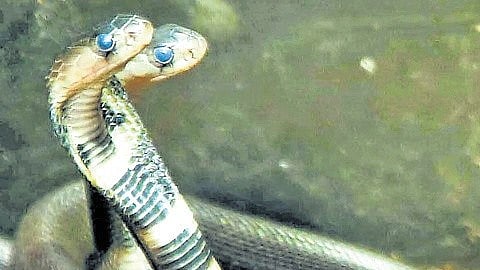

THIRUVANANTHAPURAM: Moving ahead with its plan to tackle cases of snakebites, which claimed 18 lives in 2025-26 and remain a major public health issue, the state government is exploring a partnership with Bharat Serums and Vaccines Ltd (BSV), a Mumbai-based biopharmaceutical firm, to develop polyvalent anti-snake venom (ASV) tailored to species found in Kerala.
Under it, BSV would help establish a venom collection centre at the Thrissur Zoological Park in Puthur and provide technical expertise in venom extraction, storage and transportation.
The initiative is part of the government’s push to create indigenous ASV, which experts believe will be more effective against snakes found in Kerala. At present, the antivenom supplied from Tamil Nadu and Karnataka is not fully effective here due to geographical and climatic variations.
“In our preliminary discussions, BSV expressed interest in using venom collected here to prepare antivenom specifically for Kerala,” said assistant conservator of forest Y Muhammad Anwar.
Kerala reports up to 45,000 cases of snakebites a year, with about 30% of them involving venomous snakes. Of these, roughly 335 cases are attributed to hump-nosed pit viper bites, which are difficult to treat as existing antivenom remains ineffective even at high doses.
Plan to rope in PSU dropped
The polyvalent ASV available in hospitals works against the “big four” venomous snakes: Indian cobra, Russell’s viper, common krait, and saw-scaled viper.
However, it fails to neutralize venom from other dangerous species found in the Western Ghats, such as the hump-nosed, bamboo and large-scaled pit vipers. Officials said BSV has shown interest in developing polyvalent ASV targeting two or three pit viper species.
Earlier, the Kerala State Drugs and Pharmaceuticals (KSDP), a public sector undertaking, was considered a partner for the initiative, but the plan was dropped due to financial constraints.
“Setting up a full-fledged venom collection and antivenom production centre requires heavy investment and high running costs. Collaborating with an established producer that possesses the expertise is more viable,” Anwar said.

State-specific disaster
Snakebite deaths are officially recognised as a state-specific disaster under the “human-wildlife conflict” category. Families of victims are eligible for compensation up to Rs 4 lakh through the State Disaster Response Fund, which also covers treatment costs. The government has set an ambitious target: zero snakebite deaths within the next five years