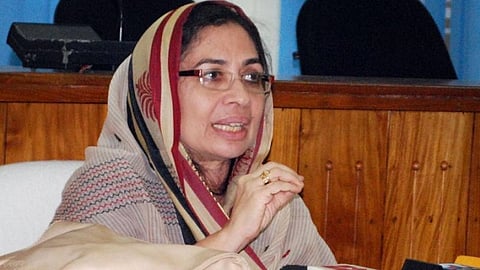

KOZHIKODE: Leaders of Indian Union Women’s League (Vanitha League), the women’s wing of the Indian Union Muslim League (IUML), have publicly questioned the party’s approach towards candidate selection for the assembly elections, with many within the wing viewing the party’s current selection as another instance of organisational marginalisation.
The IUML list released on Tuesday has two women – Jayanthi Rajan, a prominent Dalit leader from Wayanad’s indigenous community for Kuthuparamba constituency and Fathima Thahliya from Perambra. While the party projected this as a step towards inclusivity, Vanitha League leaders argue that the move bypasses several senior and experienced figures.
“The decision highlights a long-standing pattern where the Vanitha League’s contributions are neither institutionally recognised nor politically rewarded,” Noorbina Rasheed, IUWL national general secretary, told the TNIE.
She questioned the yardsticks adopted for candidate selection and sought clarity on why seasoned women leaders were overlooked despite sustained grassroots engagement.
Senior leaders such as K P Mariyumma, Suhara Mampad and P Kulusu echoed the sentiment, pointing out that the leadership did not initiate any consultation with the Vanitha League before finalising the candidates. They noted that in the previous election cycle, the women’s wing had collectively proposed Mariyumma’s candidature and were informally assured representation. However, it has not materialised, they said.
The leadership also indicated that while the party appears to be recalibrating its electoral strategy by foregrounding relatively newer faces, it has come without due acknowledgement of those who sustained the organisation over the decades. Noorbina said such decisions risk diluting internal democratic processes and weakening institutional memory within the party.
“The Vanitha League has consistently upheld the party’s ideological framework, including its engagement with secular politics, and rejected any implicit suggestion that the wing lacks alignment with these principles. Our political engagement has always been rooted in value-based politics and social responsibility,” Noorbina said.
Some leaders pointed to the enduring influence of bodies such as Samastha Kerala Jamiyyathul Ulama and its affiliates, including Sunni Yuvajana Sangham and SKSSF, suggesting that their historical reservations about women’s electoral participation continue to shape internal party decisions.