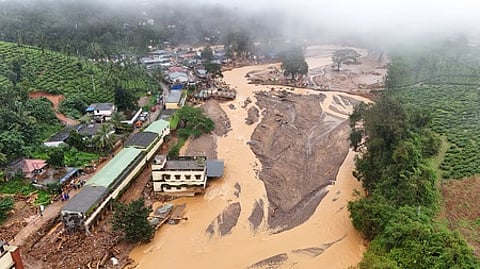

KALPETTA: Even two years after the devastating Chooralmala-Mundakkai landslide, the rehabilitation of tribal families displaced by the disaster appears to have slipped into a zone of uncertainty. With no sustained protests, little political intervention and virtually no official updates, the promised rehabilitation township for the affected tribal families remains shrouded in silence.
The second LDF government had announced that a mini township would be developed on five hectares of land at Puthiyavillage near Attamala for 13 tribal families from Erattukundu and Punchirimattom. The construction of the proposed township was entrusted to the Uralungal Labour Contract Co-operative Society (ULCCS).
The initial distribution of title deeds was carried out by then Chief Minister Pinarayi Vijayan during the inauguration of the main rehabilitation township at Elstone Estate, raising hopes among the affected families. However, little has been heard about the project since then, with the rehabilitation process apparently coming to a standstill after the ceremonial distribution of title deeds.
Meppadi panchayat secretary M Shaju told TNIE that apart from securing a no-objection certificate from the forest department for the construction of the mini township, no further action had been taken.
"During the inauguration of the township at Elstone Estate, the then LDF government had secured the NOC from the forest department for the land required to build the mini township for the tribal families. However, since then, we have not received any information or instructions regarding their rehabilitation," he said.
Several of the affected families continue to live in forest areas close to the landslide-hit region. Of the 13 families, five from Punchirimattom have been shifted to rented houses in Kalpetta. The remaining families, belonging to the Kattunayakan and other vulnerable tribal communities, continue to live deep inside the forest, close to the areas where the devastating landslides originated.
Adivasi Gotra Maha Sabha (AGMS) activist M Geethanandhan said the decision to build a separate mini township was taken after the tribal families expressed their reluctance to move to the main township at Elstone Estate.
"It was extremely difficult to convince them to come out of the forest and move into a township. During the initial discussions itself, they had made it clear that they did not want to shift to the township at Elstone Estate. That was why the government decided to build a mini township at Puthiyavillage Road, close to the forest," he said.
Geethanandhan alleged that the rehabilitation issue received attention from the previous LDF government only after protests and public pressure.
"Until the inauguration of the township, the government had not taken any concrete steps to ensure their rehabilitation. We organised protests and held press conferences, following which the LDF government distributed the title deeds. But there has been no update since then. The new UDF government, too, has not taken any meaningful steps towards the rehabilitation or protection of this vulnerable tribal community," he said.
Meanwhile, the CPM leadership in Wayanad has accused the UDF government of neglecting the survivors of the Chooralmala-Mundakkai disaster, particularly the tribal families whose rehabilitation remains incomplete.
CPM senior leader and former Kalpetta MLA CK Saseendran said the LDF government had taken the necessary steps to secure land for the rehabilitation of the tribal community, but alleged that the subsequent UDF government had failed to carry the project forward.
"The LDF government had taken every possible step to secure land for the rehabilitation of the tribal community. However, the UDF government failed to continue the work. Even the second phase of the rehabilitation works at Elstone Estate is lagging," he said.
With both governments now facing questions over the unfinished rehabilitation process, the fate of the 13 tribal families remains uncertain. For a community that was promised a safe home after one of Kerala's worst disasters, rehabilitation appears to have become yet another casualty of political transition and administrative inaction.
