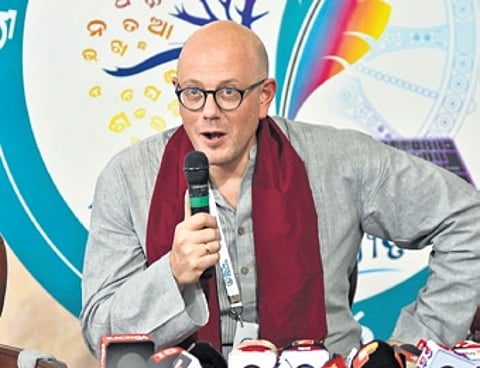

BHUBANAESWAR : France-based Indologist and Sanskritist Arlo Griffith has suggested creation of digital resources and use of technology for preservation and promotion of Odia language and literature.
Delivering a talk at the first World Odia conference on Saturday, Arlo said he has started working on digitising ‘Sarala Mahabharata’, written by Sarala Das.
Arlo, who is the head of The Jakarta Centre at EFEO (French School of Asian Studies), has been researching the ‘Paippalada’ tradition of Atharvaveda which is alive in Odisha to this day for the last over a decade. “During my research in Odisha, I came across Sarala Mahabharata and wanted to read it. This is when I realised there is a need to scan it,” recalled the professor who is a philologist, an Indologist and Sanskritist specialising in ancient epigraphy and philology of India and Southeast Asia.
In 2008, he scanned the Sarala Mahabharata at the University of Leiden and basing on it, he roped in typists from South India to type the content and reconstruct it for a wider reach. “However, the typists did not do a good job because they could not understand Odia. I had to abandon the project then,” he said.
Fluent in Odia, the researcher has now started work on digitising Sarala Mahabharata again. Stating it is very important to have digital resources in the language and literature sphere, he said dependence on printed pages limits the amount of information one can extract.
“I want to make available the published version of Sarala Mahabharata online for anyone who wants to read and research it. I have been told there are some senior scholars working on Sarala Mahabharata but one wonders if their research will be available for all to read,” he said while suggesting the state government to give out open scholarships to those wishing to conduct research on important aspects of Odia language and literature.
Because, if only two to three persons are selected by the state government to work in this sphere, their findings would be available to everyone to read, reasoned the professor who hails from Holland. “If the government is paying for research, the work done by researchers, the text and photographs should be freely available on public domain for the benefit of all,” he said.