
Prakash Behera knows the toil it takes to be an elephant tracker. He has spent weeks in the dust and grime of the summer, through the slush of farm fields, dark slurry of old coal mines in the monsoon months as well as in the cold winter nights in the forests of Angul district of Odisha. In the last seven to eight years, he and his squad mates in Talcher forest range’s Sadar section have trailed some large elephant groups.
The 26-year-old also understands the challenge of an elephant in this region. The vast expanse of paddy and vegetable fields, palm plantations and mango orchards are alluring but this landscape is now more daunting than ever for the large-bodied long rangers. Highways and roads crisscrossing their habitats, mega irrigation structures, towering power lines and innocuous looking farm fences charged with deadly electricity, the unceasing noise and humdrum of the coal mines and long queues of ore-laden vehicles have not made their life any easier.
Last month, Prakash and his squad tracked two tuskers for close to two weeks. The elephants came into Angul forest division from adjoining Hindol range and had to be followed through Ganthigadia, Nalco plant, Balanda, Raijharana, Angul, Kuiya, Boinda till they crossed over to Athamallik division.
It must have been about 100 km. The team had to be watchful, as they would alert villages to avoid encounters; coordinate with electricity officials to shut down power and keep villagers calm after episodes of depredation. “Forest department’s task is to ensure that harm does not come in the way of either humans or elephants,” Prakash says.
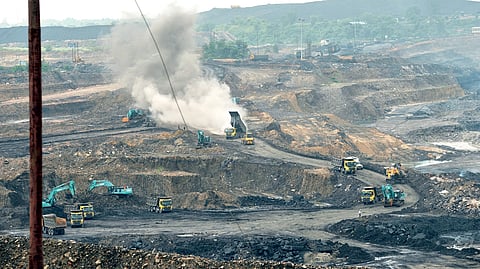
But the problems are mounting. From the larger Chhotanagpur Plateau that holds India’s largest reserve of iron ore to the coal belt of Angul-Talcher, the mineral has merely changed as country’s surging demand for fossil fuel threatens to put pressure on a large elephant population in Odisha’s coal-belt. Angul is home to one of the most significant elephant populations and sits on Odisha’s richest coal reserves.
In 2015, a study by Kisor Chaudhuri titled “Impact of mining on elephants of Chhotanagpur Plateau, Central India” analysed the impact of iron ore mining on elephants of Keonjhar. Between 2001 and 2009, a mind-boggling 64,000 hectare prime elephant use areas were leased out for mining in Keonjhar along with another 11,000 hectare in Singhbhum of Jharkhand and these land were stripped of vegetation, leaving the animals to wander for food.
A latest Care Edge report said, by March this year, the country’s coal production reached the 1 billion tonne (BT) mark, logging at a 10 per cent (pc) compound annual growth rate over the last five years. Coal consumption was driven by the demand from the power sector, which accounted for 82 pc of the 1,270 million tonne (MT) coal dispatches in 2024-25 fiscal. “India is firmly progressing towards self-sufficiency, with domestic coal production set to hit the 1.15 BT landmark in 2025-26,” it said.
A good share of the targeted coal production will come from the central pockets of Odisha, Angul to be particular.
History repeating itself
As coal activity sees an uptick, driven by the energy demands of the country, the stress on elephants would be undeniably pronounced in Angul forest circle, a prime elephant habitat. In the winter census of 2024, about 2,103 elephants were enumerated in the state, of which 680 were from Angul circle, comprising seven wildlife and forest divisions. The Angul forest division alone accounted for 117 elephants with neighbouring Dhenkanal home to 296 of these long-ranging animals. The Satkosia Wildlife Sanctuary is also its part.
“This region is significant because it is part of Mahanadi Elephant Reserve (ER) and links Sambalpur ER. Coal is important but mining plans must also be seen from an elephant conservation point of view. Elephant population in Angul circle is extremely stressed,” points out former member-secretary of the National Tiger Conservation Authority (NTCA) Anup Kumar Nayak.
Statistics from the Forest department of Odisha reveals that between 2020 and 2023, about 1,269 hectare forest land was diverted in Angul district for non-forestry uses. Of that, mining required diversion of 1,077 hectare which form prime elephant use land. The rest was for road, railway, transmission lines, stone quarry and pump house. Most, in one way or the other, adds to the problems for elephants of the region.
The Keonjhar case study is an eye-opener. “Activities peripheral to actual mining, like operation of crushing plants, transportation of ore by road through vulnerable forest patches and blasting day and night for recovery of minerals and generating deafening sounds, increased. During the peak demand period of 2006 and 2011, 18,000 ore-laden trucks passed through National Highway 215 that connects Joda block with the seaport of Paradip, causing permanent closure of elephant transit paths through Sidhamath and Thakhurani Reserve Forests in Odisha and Singhbhum Elephant Reserve in Jharkhand,” Chaudhuri’s study revealed.
During 2011-2006, he noted, elephant depredation in Keonjhar district showed a dramatic decline, primarily because of a drop in number of their population in mining pockets only to double up in neighbouring Dhenkanal. Elephant deaths almost doubled, as did crop damage.

Like Keonjhar’s iron ore reserves, Angul’s coal blocks are tightly grouped, leaving very little space for transit and movement of the big animals. An elephant movement toposheet generated by the Forest department for Angul showed large groups of elephants using compact areas located to the south of coal blocks, much closer to urban, semi-urban and rural settlements.
It is in this region that human-elephant conflict has grown alarmingly. Growing number of industries, linear infrastructure such as irrigation, national highways as well as power lines have already left elephant movement and migration restricted. The fragmented migration corridors have added to their problem. With more coal mines in the offing, the future looks ominous.
The human-elephant conflict (HEC) data is telling. Between 2019-20 and 2024-25, Angul district reported 68 elephant deaths. During the period, 124 human lives were lost to elephant attacks. In terms of depredation, crop damage area jumped from 2,678 acre in 2019-20 to 3,453 acre in 2024-25. The government paid about Rs 20 crore towards crop damage compensation whereas total compassionate payment was Rs 26 crore. In the 10 years between 2014 and 2024, Angul and Dhenkanal districts, one of the worst HEC zones of the country, reported 216 elephant deaths, close to 28 per cent of the fatalities (776) recorded in the state.
Dr Sreedhar Vijayakrishnan, research affiliate with Sri Lanka-based Centre for Conservation and Research, says elephants being extremely adaptive animals can modify their behaviour to avoid regions overlapping humans while also exploiting the resources through crop raiding. Studies in Sri Lanka and Malaysia shows elephants prefer these disturbed areas because of the high-level of nutrition available there, he points out.
“Though not directly comparable to coal mining, oil palm plantation establishment in Malaysia is a relevant example. To meet the global demand for oil palm, large-scale rainforests were removed in south-east Asian countries like Malaysia and Cambodia. As more and more oil palm plantations were established, elephants tend to be using the modified or disturbed or secondary areas more than the rainforests which means conflict could be intense,” he adds.
Against the conventional notion that elephants use undisturbed, contiguous primary forests, evidence is to the contrary. “Of course, we need primary, contiguous forests for long-term conservation, but elephants are going to use these disturbed areas also. In oil palm regions of Malaysia, measures such as translocations have been carried out, which have often been futile. Elephants continue to use these areas due to the high resource availability in the plantations. In coalfields, however, resources are limited and disturbances are high, which could lead to displacement of elephants and in turn increased conflicts in neighbouring areas. It’s a possibility, I foresee,” he says.
If coal mining triggers more displacement of elephants, crop raids and property damage may spike. There will be increased use of electrified fences, traps and retaliatory killings. In the last one month-and-a-half, five elephants died in charged solar fences under Angul forest circle alone.
More in the offing
With its coal resources measured at a staggering 94.5 BT, Odisha is right at the top among the states, ahead of Jharkhand’s 87.84 BT. Almost a quarter of India’s coal is produced in the state. In 2021-22, coal production in Odisha stood at 185 MT; it jumped to 239 MT in 2023-24, a 29 per cent leap in a manner of three years, according to Coal Ministry data.
Angul takes the crown. Of the four coal-bearing districts of Odisha, it alone accounts for 45 per cent of the mines. Statistics shows that the district recorded a 19.7 per cent jump in coal production – from 96.73 MT to 115.06 MT between 2021-22 and 2023-24, logging half the coal production of the state.
As India’s fossil fuel demand remains strong, Coal India Ltd (CIL) alone looks at a staggering 1 BT production by 2028-29. A substantial share of the production is going to come from its arm Mahanadi Coalfield Ltd (MCL) which aims to contribute about 285 MT to the central PSU’s basket. By 2034-35, MCL’s plan is to hit the 358 MT mark.
There are 12 operational coal mines in Angul district with seven run by MCL. Two more are in the pipeline. Subhadra open cast project, located in Chhendipada block, is expected to be operational by 2025-26. It has a reserve of 25 MT. Balabhadra, with a 10 MT reserve, targets to start operations by 2029-30.
There are 66 coal blocks in Angul district. With the demand for coal on the rise, more and more mines could come into operation in the days to come. The Coal ministry information reveals that Coal India has identified nine coal blocks in Odisha with a combined peak rated capacity of 132 MT. Six of them, with 85 MT capacity, are in Angul district.
Apart from those operated by MCL as well as captive mines, more players have stepped in with the doors thrown open for commercial mining. Between 2021 and 2025, allotments for 20 commercial mines have been made in the state.
A new study by Wildlife Institute of India (WII) has suggested that Angul forest division will lose 390 sq km of forests if all the inactive coal blocks in the region come into operation. It is food for thought.
Cut-off corridors on the rise
Conservation advocates say more mines coming into operation would lead to severe disruption of the elephant corridor. This region is part of the Satkosia-Kapilas-Keonjhar corridor network and expanding mining would completely sever one of the last viable north–south pathways used by elephants moving from Satkosia Tiger Reserve and Mahanadi RF to Kapilas and Keonjhar forests.
Linear infrastructure, industrialisation and urban expansion have already critically impacted corridors like Kanheijena-Anantapur route which once linked Satkosia-Kapilas-Keonjhar areas. The Rengali canal and dam further partitioned corridors, restricting elephants’ seasonal migratory routes. New mining expansion would threaten more forests in Angul forest division deemed prime for elephant movement, says a conservationist.
Founder of Save Elephant Foundation Trust and former Lokayuta member Dr Debabrata Swain, who undertook extensive survey of the elephant corridors and also co-authored a book, mentions that a major group of elephant has been islanded in Kaniha-Talcher-Chhendipada (all in Angul district) in absence of connectivity to neighbouring Athamallik forest division. The corridor is cut off by canals, railway lines, state highways and inter-mingled coal-lines.
“A corridor of 1 km width from Anantpur reserve forest to Chhendipada can be carved out to make the Similipal-Satkosia route functional. It would require just 100 sq km out of the 1,800 sq km Talcher coalfield which is not asking for too much,” he says.
Habitat fragmentation and disrupted corridors tend to isolate sub-populations causing reduced gene flow and long-term viability and the risk of inbreeding is higher in small herds. Besides, it can lead to erratic movements and panic-driven crop raiding which the region could well be witnessing.
Dr Sandeep Tiwari, Head of Conservation at Wildlife Trust of India, believes securing corridors can help elephants in such disturbed landscapes. “The problem is if the existing corridors are not protected or secured, elephants will be forced to explore and use new movement paths between habitats. In Odisha, of the 14 corridors identified, many of them need urgent attention and must be protected and secured,” he says.
Ashok Satpathy, a development practitioner of Angul says local communities in Chhendipada, Banharpal, Hindol, Bantala and Athamallik blocks are already facing high levels of conflict. Mining causes elephants to avoid core forest areas and move into fringe villages. Besides, more mining could impact the Sal-dominated moist deciduous forests critical for elephant shade and resting in the ranging regions. Fragmented habitat leads to chronic stress, altering foraging and social structures, and increasing aggressive or unpredictable movements.
Solutions for a way forward
Dr Vijayakrishnan, who holds a PhD in Behavioural Ecology, pitches for radio-collaring elephants in the impact zones. “In Sri Lanka, the governments and conservation bodies have radio-collared over 200 elephants in the last 25 years. They have extensive datasets on ranging patterns, corridor usage and response to translocation, which is quite amazing, as it can inform conservation decision-making directly,” he says.
Tiwari feels legal status to the corridors will put more onus on the state to protect them and revive some of the impaired ones. “Most corridors have mixed land-use (forest, private, leased) and hence involve multi-agency. But notification will help in better coordination, planning and implementation and resources to protect,” he explains.
Former chief wildlife warden of Odisha Susanta Nanda also favours a legal notification of corridors saying legal safeguards could be critical ahead of further mining approvals. “Strategically constructed underpasses or overpasses (especially near highways and canals) can preserve corridor continuity while restoration of degraded forest patches and maintaining buffer zones outside core protected areas can offer alternative foraging zones and reduce pressure on narrow corridors,” he adds.