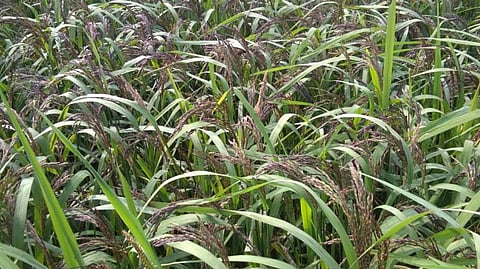

ROURKELA: Indigenous aromatic and non-aromatic paddy cultivated with natural farming methods is showing moderate yields compared to modern farming in Sundargarh district. The ongoing crop cutting experiment has brought to fore the interesting new trend.
Paddy farmers associated with natural farming stand to get more financial benefits due to high market price and demand for indigenous aromatic and non-aromatic paddy varieties.
In 2025-26 kharif crop season, around 8,300 hectares (ha) in Sundargarh were covered under the ‘Promotion of Indigenous Aromatic and Non-Aromatic Paddy with Export Potential/ Local Market’ scheme. The scheme aims to revitalise traditional rice varieties, enhance market value and improve farmer livelihoods with emphasis to tap export potential. It also seeks to cater to the local market demand.
Under the scheme in Sundargarh, about 70 per cent of 8,300 hectare has been covered with indigenous non-basmati aromatic paddy varieties of Gitanjali, Ketaki Joha, Badshah Bhog and Sugandha. The remaining 30 per cent area has been cultivated with the non-aromatic variety of Kala Champa.
The average paddy yield under the modern farming method using chemical inputs is 36 quintal per hectare in Sundargarh, sources in Agriculture department said. As per ongoing crop cutting experiment results, per hectare yield with natural farming under the scheme is between 24 quintal and 28 quintal.
In some pockets of the Bonai sub-division including Bonai and Gurundia blocks, the yield has shown up to 28 quintals, while in other pockets such as Tangarpali and Lefripada blocks, it stands at 24-25 quintal.
The sources said the minimum support price for normal varieties of paddy under modern farming has been fixed at Rs 3,100 per quintal. Yet, beneficiary farmers under the scheme would get assured price of Rs 4,100 per quintal for indigenous non-basmati aromatic and non-aromatic paddy. Along with cash incentive, seed, bio-inputs support and high market price and demand, farmers stand to gain more under the scheme.
The scheme provides three years support to beneficiaries. Implemented in 2023-24 in Sundargarh with 1,000 hectare, the area coverage in the second year was expanded to 5,300 hectare in 2024-25. In 2025-26, it was extended to around 8,300 hectare. Farmers are entitled to a cash incentive of Rs 5,000 per hectare, 45 kg of indigenous seed and bio-input subsidies of Rs 7,000 in the first year. In the second, the cash incentive drops to Rs 4,000 and input subsidies to Rs 2,500. In the third year, it falls to Rs 3,500 and Rs 2,000 respectively.
Chief district agriculture officer LB Mallick said the crop yield trend of indigenous aromatic and non-aromatic paddy varieties is encouraging. “The farmers would stick to natural farming of indigenous varieties even after end of the scheme. Due to nutritious and health values of indigenous varieties, people are increasingly getting attracted to chemical free food grains,” he added.
