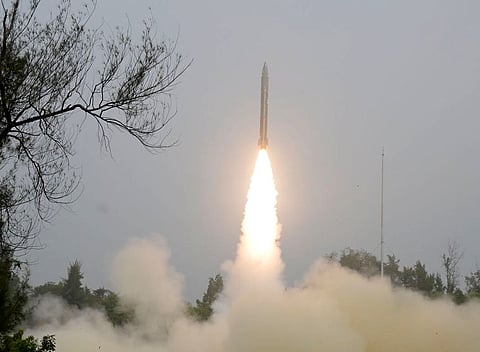

BHUBANESWAR: India’s newly developed tactical short-range ballistic missile (SRBM) Pralay on Wednesday cleared user evaluation trials during back-to-back tests in salvo mode from a defence facility off the Odisha coast on the eve of the New Year 2026, paving the way for its early induction into the armed forces.
Defence sources said two rounds of the canisterised missile were successfully flight-tested in quick succession from the same launcher positioned at the Integrated Test Range (ITR) at Chandipur.
Developed by the Defence Research and Development Organisation (DRDO), Pralay is an indigenously developed solid-propellant quasi-ballistic missile employing state-of-the-art guidance and navigation systems to ensure high precision. The missile is capable of carrying multiple types of warheads against various targets.
“The missiles precisely followed the intended trajectory, demonstrated mid-air manoeuvres and hit-to-kill with pinpoint accuracy, meeting all the mission objectives. The user evaluation trials validated the maximum and minimum range capability of the missile. It is now ready for induction,” sources said.
For the tests, the systems were integrated by the two development-cum-production partners. The trials were witnessed by senior scientists from DRDO, representatives of the users from the Indian Air Force (IAF) and the Indian Army, as well as industry representatives, including the development-cum-production partners.
Pralay is part of the country’s strategic integrated rocket force, a dedicated wing of the Strategic Forces Command (SFC). Comparable to China’s Dong Feng-12, Russia’s 9K720 Iskander, the US Army’s Precision Strike Missile (PrSM) and South Korea’s Hyunmoo-2, Pralay can deceive anti-ballistic missile interceptors.
Fuelled by composite propellant, the missile employs advanced guidance and navigation systems to ensure high precision. It is capable of carrying multiple types of warheads against various targets at ranges of up to 500 km.
The five-tonne missile, with a payload of one tonne, can travel a distance of 350 km, and if the payload is halved, it can strike targets as far as 500 km.
“Pralay has several unique features. The missile is a derivative of the Prithvi defence vehicle exo-atmospheric interceptor missile and is capable of destroying enemy weapons at high altitudes. It can fly at hypersonic speed in a quasi-ballistic trajectory and perform terminal manoeuvres to delude the ballistic missile defence of the enemy,” a defence scientist said.
The missile has been developed by the Hyderabad-based Research Centre Imarat (RCI) in collaboration with other DRDO laboratories, including the Defence Research and Development Laboratory (DRDL), Advanced Systems Laboratory (ASL), Armament Research and Development Establishment (ARDE), High Energy Materials Research Laboratory (HEMRL), Defence Metallurgical Research Laboratory (DMRL) and Terminal Ballistics Research Laboratory (TBRL).
Secretary of the Department of Defence R&D and chairman of DRDO, Samir V Kamat, congratulated the DRDO teams involved in the successful flight tests. He said the achievement indicated the imminent readiness of the system for induction by the users.
The Pralay project was sanctioned in March 2015 and has been under a series of developmental trials for the last two years. The terminal events of the twin tests were confirmed by telemetry systems installed onboard a ship deployed near the impact points.
Defence Minister Rajnath Singh complimented DRDO, the IAF, the Indian Army, defence PSUs and the industry on the successful launch of the missiles in quick succession. “The successful completion of the salvo launch of the Pralay missile has established the reliability of the missile,” he said.
