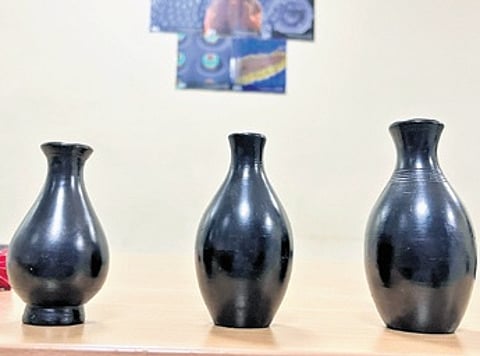

ROURKELA Researchers of the Ceramic Engineering department at National Institute of Technology-Rourkela (NIT-R) have secured patent for an eco-friendly and sustainable method for manufacturing black terracotta wares by integrating traditional artisan knowledge with modern technology.
The innovative process involves indirect heating of ‘as-fabricated’ bodies in an electric-powered enclosed vacuum (air-depleted) chamber. Compared to the traditional methods, there is no generation of smoke containing toxic gases including carbon monoxide, carbon dioxide, sulfur oxides and nitrogen oxides.
The existing typical processes involve 48 hours of firing cycle. In the new unique process, firing duration gets cut down by seven times. It also requires no organic solid fuel, skilled hand and specialised clay, yet ensures uniform shiny and mirror finish outcomes.
The research team led by Prof Swadesh Kumar Pratihar along with senior technical assistant Shiv Kumar Verma and research graduate Rupesh Mandal recently secured the patent titled ‘Process for Producing Black Terracotta Wares & System for Producing Thereof’.
The researchers said terracotta or ‘baked earth’ has been extensively used in India for kitchenware (utensils), temple sculptures and roofing tiles. Red terracotta is made by firing common clay in the presence of air. The presence of iron in clay, when exposed to fire, leads to oxidation, resulting in its characteristic red colour. Similarly, black pottery is made in India and its neighbouring regions using techniques that are generations old.
One such example is the Nizamabad black pottery of Uttar Pradesh, where semi-finished wares are coated with a glaze made of clay and native vegetable-based material called ‘kabiz’, and polished with mustard oil for shiny and mirror finish. It is then fired in a sealed iron vessel along with cow dung, straw and wood chips. Crafting beautiful black ware requires time, effort, constant monitoring, specialised clay, skilled hands and organic fuel in solid form. In Tibet’s Nixi village, artisans use coarse red clay mixed with white sand and powdered black baked quartz before firing with wooden logs, they added.
The research was aimed at eliminating the major drawbacks of these generation-old processes and get a sustainable, less cumbersome and eco-friendly process. Prof Pratihar said, “This sustainable production technique combines the traditional knowledge of artisans with modern technology. The key to this process lies in indirectly firing the prepared pots in a sealed, vacuum (air-free) chamber. During this firing process, the hydrocarbon-rich oil waste oil undergoes pyrolysis process (decomposition), generating carbon monoxide and carbon soot. This creates a reducing atmosphere, which is essential for developing the black colour on the pottery.”
The unique technique is seen as a significant contribution to environmental conservation and heritage preservation.
