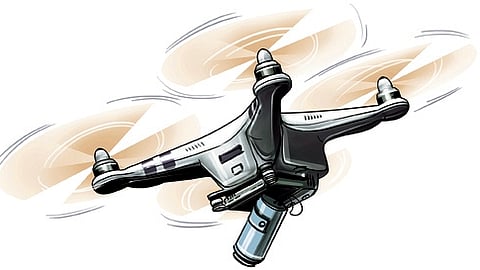

ROURKELA: A team of researchers at the National Institute of Technology-Rourkela (NIT-R) has secured a patent for BHU-MANACHITRA, an advanced drone technology for real-time mapping of land.
The innovative drone system uses artificial intelligence (AI) and unmanned aerial vehicle (UAV) technology to automatically generate land maps without needing internet connectivity, external computers or manual interventions.
Significantly, unlike conventional drones, the deep-learning model is capable of recognising distinct land features like farms, forests, vegetation and urban areas besides performing all processing onboard.
Associate professor in Computer Science & Engineering department of NIT-R Sambit Bakshi, who led the research team, said the invented methodology uses a lightweight AI model with as low as 2.48 million parameters, which makes BHU-MANACHITRA suitable for on-board processing in drones. “Being designed lightweight for long flight time, drones cannot carry heavy dedicated hardware for real-time image processing. But, they can carry a tiny enough processor for executing this lightweight AI model that performs land mapping,” he informed.
The researchers said land mapping remains essential to identify farmlands, forests, vegetation and urban areas for geographic governance including basis for planning, infrastructure development, natural resource management and environmental monitoring. For land mapping, India relies heavily on the time-consuming and error-prone manual surveys. Recent use of drones for taking images of distant terrains too involves a time-consuming lab processing to produce readable map.
While deep learning models are being developed worldwide to help interpret aerial images, these often struggle to identify roads, buildings, and vegetation due to overcrowding of multiple objects. These models are often prone to produce inaccurate or unstable maps during real-time use.
The researchers said their model successfully addresses the limitations of the existing systems. BHU-MANACHITRA is self-sufficient and particularly valuable for remote locations, disaster-hit regions or areas with no communication networks. The new technology can be used for land record modernisation, urban planning, smart city development, instant assessment of crop condition, soil health, irrigation coverage, monitoring of deforestation, encroachment of forest land, changes in biodiversity and quick natural disaster management response with terrain information during floods, landslides and earthquakes.
NIT-R and Vishlesan I-Hub Foundation of Indian Institute of Technology (IIT), Patna have jointly been granted the patent for the technology. The Technology Innovation Hub (TIH) of IIT, Patna sponsored the research project through the National Mission on Interdisciplinary Cyber Physical System (NM-ICPS) of the Department Science and Technology. The NIT-R team carried out the research independently.
Research graduates of NIT-R Tanmay Kumar Behera and Debbrota Paul Chowdhury besides scholar Camellia Ray were also part of the team.
