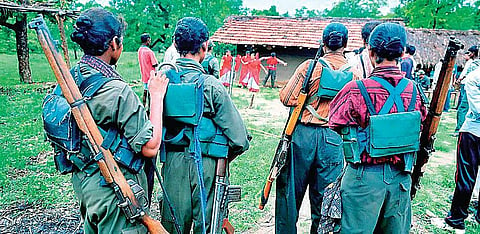

BHUBANESWAR: With the Centre setting March 2026 as the target for a Maoist-free India, the Odisha government has almost doubled the financial assistance offered to left-wing extremists (LWEs) who voluntarily surrender and return to the mainstream.
According to a fresh notification issued by the Home Department, Maoists surrendering with a light machine gun (LMG) will now receive ₹4.95 lakh, while those giving up an AK-47 or Trichy assault rifle will be entitled to ₹3.3 lakh.
Assistance of ₹2.75 lakh has been announced for those surrendering with a 2-inch mortar, ₹1.65 lakh for an SLR/INSAS rifle, ₹1.1 lakh for an X95 assault rifle/MP-9 tactical, ₹82,500 for a .303 rifle, ₹66,000 for an X-Caliber 5.56mm, ₹44,000 for a UBGL attachment, and ₹55 per round of ammunition, one of the most generous compensatory structures introduced in the state so far.
The modified surrender and rehabilitation scheme aims to provide surrendered Maoists with gainful employment and entrepreneurial opportunities to ensure they do not revert to extremism.
“The new policy replaces earlier schemes notified in 2006, 2012 and 2014 and aligns Odisha’s framework with the revised guidelines issued by the Union Ministry of Home Affairs. The overhaul was essential to wean away misguided youth who have joined the CPI (Maoist) and its frontal organisations,” stated the notification.
With the objective of containing and ultimately eradicating left-wing extremism by providing viable alternatives for livelihoods, education and reintegration, the government has set strict eligibility criteria.
Only cadres from the banned CPI (Maoist) and its proscribed frontal organisations can avail the benefits.
LWEs can access the scheme after surrendering voluntarily, revealing their true identities, providing details of associates, financiers and supply chains, confessing to their roles in violent incidents, and making a public declaration of surrender.
Surrenders may be made before designated police, district or Central Armed Police Force officers, after which security will be provided and antecedents verified.
Under the revised package, higher-ranked surrenderees, including central committee secretaries, central military commission chiefs or politburo members, will receive up to ₹5 lakh depending on rank and position, while middle- and lower-ranked cadres will get up to ₹2.5 lakh.
In both cases, ₹50,000 will be provided in cash immediately and the remaining amount placed in fixed deposits jointly operated with the district nodal officer, to be released in phases based on good conduct over one and three years.
In addition to weapon compensation, each surrendered Maoist will receive a ₹25,000 incentive irrespective of whether they deposit arms. Those with a government-declared reward of ₹5 lakh or more will receive an additional lump-sum of ₹10 lakh, which will be locked in a fixed deposit for three years.
The revised reward for wanted extremists ranges from ₹1.1 crore for a politburo or central committee member to ₹1.65 lakh for dalam or cadre members.
The scheme also includes a wide range of welfare measures, such as allotment of a house under the Antyodaya Gruha Yojana or cash compensation where land availability is an issue, a marriage incentive of ₹25,000, and priority enrolment in skill-development programmes at ITIs, polytechnics or other government training centres.
Surrendered cadres will receive a monthly stipend of ₹10,000 for up to 36 months, discontinuing only upon securing employment. They will also receive health cards under state or central schemes, free or subsidised ration under the Pradhan Mantri Garib Kalyan Anna Yojana (PMGKAY) and Antyodaya, and counselling support through model career centres.
“Trials for heinous crimes will continue in court, though the government may consider withdrawal of prosecution or plea bargaining for minor cases. Fast-track courts may be constituted for expeditious disposal of cases involving surrenderees. If a surrendered cadre returns to extremist activities or is found secretly assisting Maoists, all accrued benefits will be forfeited,” the notification read.
The state government has also clarified that couples surrendering together will be treated as separate units for all financial and rehabilitation benefits, except under schemes where husband and wife are mandatorily treated as a single unit.
Experts believe the scheme is unlikely to influence higher-ranked Maoists who have allegedly already accumulated considerable wealth. “The revised policy, however, may encourage the lower and middle-ranked cadres. The top echelon may not feel enthusiastic at all because they are already well-settled. But for those in the lower and middle levels, this could act as a motivation to work with greater integrity and transparency,” said former DGP Bipin Bihari Mishra.
