
JEYPORE/BARIPADA /BALASORE/BHAWANIPATNA: Odisha is currently basking in the festive glow as Durga Puja is being celebrated with pomp and gaiety in every nook and corner of the state.
In Koraput district, spiritual fervour gripped residents as they observed Maha Ashtami with devotion and grandeur on Tuesday. Temples of Bhagabati, Dakshina Kali, Mutyalamma and Birikomb drew large gatherings of devotees, where special rituals were performed to mark the auspicious occasion.
In several tribal villages across Koraput, Pottangi, Nandapur, Dasmantpur, Borigumma and Kotpad blocks, animal sacrifices were performed as a way of paying obeisance to Goddess Durga. About 22 sacred lathis of the Devi arrived from different parts of undivided Koraput district for the age-old Dussehra celebrations in Jeypore.
These lathis will be worshipped at the Bhagabati and Dakshina Kali temples till conclusion of the festival. Nearly 30 beautifully decorated pandals have been erected across the district, adding colour to the festive atmosphere.
In Murgabadi at Baripada of Mayurbhanj district, the Mother Goddess is offered a bhog of Dahi Pakhala and fried fish on the occasion of Vijaya Dashami or Dussehra, the concluding day of the festival. The festival entered its 45th year this Puja.

Married women gather to play Sindoor Khela where they seek the blessings of Maa Durga by applying vermilion on Her feet and then proceed to smear it on one another as everyone gears up to bid an emotional adieu to the goddess.
It was in 1980 that a group of local residents started the festival in Murgabadi with just Rs 3,500. Now with setting up of extravagant pandals, decorative lights and earthen images of the goddess and other deities, the budget has gone up to Rs 8 lakh, said committee president Manoranjan Kabat.
On Ashtami, priests perform Ashtami puja and chant mantras to appease the goddess. Unlike other puja pandals, the committee at Murgabadi lays emphasis on the prasad than the cultural programmes, Kabat said. In Sahid Padia puja mandap, people look forward to taking part in the Sindoor Khela which is organised in a grand way.
In Balasore town, Akhada Khela, a traditional form of martial art, is performed during the idol immersion ceremonies. This century-old tradition began in 1925 under the guidance of the then chief minister Dr Harekrushna Mahatab.
During British rule, local youths were trained in the martial art form for defence purpose but it slowly developed into an inseparable part of the folk culture. Every year during the idol immersion ceremony of Goddess Durga, young men and women skilled in Akhada Khela demonstrate their skills.
“The history of this martial art dates back to 1925. It was started in Balasore by Dr Mahatab. A Sardar named Benga Sethi used to visit various places in the district and impart training on the martial art form. That is how it became popular,” said committee members Manoj kumar Das, Fakulu Rout and Kanhu Sahoo. Armed with lathis (sticks), spears, swords, shields and other traditional weapons, artistes perform with zeal and discipline.
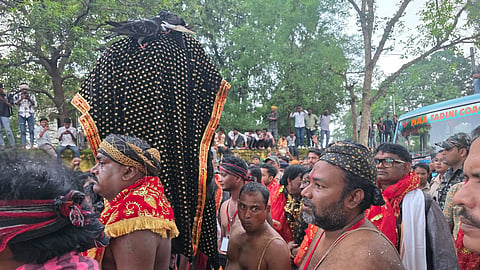
Bhawanipatna, meanwhile, witnessed a huge footfall of devotees from within and outside the state as the famous Chattar Yatra of Goddess Manikeshwari concluded on the day. After Sandhi Puja in the temple at midnight, the deity was secretly taken to Jena Khal located 3 km away, as servitors played Jena Badya.
In the wee hours of the day, the Chattar was taken out in a procession throughout the town accompanied by beats of Jena Badya, Ghumura, Nisam Ghanta and folk music. While some devotees offered puja to the Chattar and released doves, many sacrificed animals to appease the goddess.
After the Chattar reached the temple, the king received it from the priests and placed it at the sanctum sanctorum.There was massive deployment of security personnel for smooth conduct of the yatra.