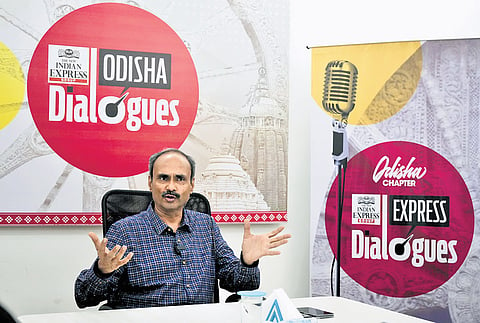

Odisha is witnessing a generational shift in public sentiment - from resistance to demand for industry. This consensus mindset is shaping Odisha’s industrial surge and giving speed to the journey towards becoming a developed state by 2036, asserts additional chief secretary, Industries department, Hemant Sharma at TNIE Odisha Dialogues.
The state government has started working on its vision Viksit Odisha @2036 for Viksit Bharat @2047 with industrial development as a key pillar. Could you elaborate on the roadmap for achieving the goal?
Vision 2036 and Vision 2047 are two important milestones in the development journey of Odisha. Basically, three major sectors – agriculture, manufacturing and services play crucial rules for any state’s economy. It is a general consensus for any state or region to develop that the relative share of agriculture should go down, manufacturing should go up and services should go up even further.
The vision in simpler terms is that the relative contribution of services and manufacturing should grow vis-a-vis each other and vis-a-vis agriculture. That does not mean the importance of agriculture will diminish. Today, if our GSDP is Rs 100 and Rs 40 comes from agriculture, tomorrow our GSDP should become Rs 1,000. But out of Rs 1,000, instead of Rs 400 coming from agriculture, we should have only Rs 100 from agriculture, which means it will double – from Rs 40 to Rs 100, almost 2.5 times. But manufacturing and services will have to grow even bigger. We know our per capita income should go up, GSDP should go up and agriculture, manufacturing and services should grow to reach this particular level. Therefore, industrial development is our approach to Vision 2036.

We have a very natural competitive strength in mining and metallurgy and they will continue to remain our backbone. The prime growth will happen in these industries. In mining today, we are at about only 5 per cent of our growth potential. Some of these minerals are entering new phases of their growth cycle. Coal for instance till 2030-2050 will be primarily used for energy. Beyond that it will have to be used for chemicals, for other ways of development. If we do not do that now – till 2036 or 2047, this mineral will go out of our bouquet. The same is for iron ore and bauxite. Today, at least 85 per cent of the aluminium produced in Europe or America, is from recycled materials. Same thing is for steel and stainless steel. We are in the mid-stage of development of the metallurgical industry. Which means we not only need more iron, more bauxite, more limestone or more rare earth, we also need more steel, stainless steel, aluminium and cement. For that to happen, we have to enable large-scale industrialisation. Speed needs to grow substantially, which is really not the case as of now.
Similarly, we have a coastline of around 500 km and we have only three ports. Our neighbouring state Andhra Pradesh has a coastline of 1,000 km but now they actually have 12 ports, Gujarat has 60 and Maharashtra 48. All these ports have come up within last 25 to 30 years, which means that even there, our speed of growth and our level of development is far below our potential. If we were to become a Viksit Odisha by 2036, the three ports should become at least 15.
This cannot happen just by having a vision document or by having good people to govern. There has to be a consensus of opinion. Every section of the society in Odisha should realise or feel this lack of development and then agree, yes, we will modernise agriculture. We will have more industries. We have to give up land for industrial development. The consensus of opinion is the crux of Viksit Odisha.
You have been in the administration for last 30 years. What do you think is the main reason for Odisha lagging in the speed of development?
One single biggest reason is lack of resources. We are theoretically rich, practically poor. Till 2015 or 2016, our budget was around Rs 60,000 crore to Rs 80,000 crore. Today, it has crossed Rs 2 lakh crore. Fortunately, things are now changing because of the additional revenues which we have started getting for last few years and the investments which have started coming in. The money is now available with the state government to spend on infrastructure and development activities where the resource base has increased.
Despite the challenges, how can Odisha achieve the goals within next 10 years?
There are two-three things. There is a generational shift which is happening. You go to Mahakalapada today and speak to the people. People in their 20s are asking why they should go to Bengaluru for a job. Why doesn’t the government set up a factory in their place? In public hearings, people in Mahakalapada, Dhinkia or Govindpur ask why it took so many years. Twenty years back, people were resisting. We were not even able to hold a Palli Sabha, forget a public hearing. The generational shift itself is making the consensus happen. Now people are asking why there is no industry in their locality, which was unheard of a few years ago. While preparing the Vision document, the government organised various stakeholders meets and made people voice their concerns which helped bring about a common ground. A majority of the public opinion was in the favour of the pathway.
How do you see Odisha’s competitiveness as compared to states like Maharashtra, Gujarat and Tamil Nadu? If one project is taken by Gujarat, there is a huge uproar in Maharashtra. This kind of competitiveness or attitude is not seen in Odisha.
It is building up now. We have a lot of pressure of performance from within the society on why Odisha is not aggressive as it should be or as seen in many other states. Frankly speaking, much of that has to do with our inability to deliver. Today, it is easier to get a project, but difficult to execute it. In June, we signed 33 MoUs during the Odisha textiles conclave and all of them are waiting for land. Some of them have already expressed disappointment over the delay in land allotment. We have a long way to go. Everybody in the system has to feel the same sense of urgency for this to happen.
What are the main hindrances?
We are good at ease of doing business and single window clearances. The problem areas are land, logistics and law and order. Land continues to be a pain, because the demand has gone up by 10 times. When I was the director of Industries from 2006 to 2009, we used to deal with 50 acre or 100 acre in a year. Now it has gone up to 10,000 acre in a year. Commensurately, the manpower required to manage is not there.
We are trying to build up our system and handhold the officials at the district and tehsil level to support them to deal with such situations effectively. We now have trained people deployed at various levels to expedite things. In every district, we have opened a district investment promotion agency (DIPA). It is a three-member committee mandated for identification of land, facilitating investors and resolving issues in direct consultation with the collector’s office. This is why our turnaround time has gone down. We have the best policies in the country that no one can match. We are good at both pre-commissioning and post-commissioning stages, but we need to improve the commissioning stage. Our ability to release incentives is also better than other states due to our fiscal discipline.
What is the political understanding of the situation?
Political understanding is absolutely clear. Otherwise, it would not have been possible for us to organise single-window meetings every month. There is absolutely clear cut political understanding and clarity on this. The single most important item for any political party in the country today is the creation of jobs. Everybody can actually sense it that without creating jobs it is not possible to continue. All know that it is not going to happen in traditional agriculture. Manufacturing and services can only help generate jobs. We are fortunate that we do not need to convince them, they are already convinced.
The Make-in-Odisha initiative has attracted huge investment interest for the state. But, what is the ground reality? The conversion rate of real projects seems to be missing.
We have learnt from our past mistakes. We are not chasing any theoretical investments. We have become very choosy. Out of more than 600 investment proposals we received during the last conclave in January, only 150 MoUs were signed, which means we rejected 450 proposals. We have been very careful. In last 15 months, the performance on the actual grounding of investments is better than that of last seven years. The per month and per year average is also much better.
The chief minister has set the target asking to only bring in the ground-breaking instances to his notice, not the MoUs. Every month, he has a target. For this, I have absolutely full freedom, full mandate to execute and grounding the projects as per legal provisions. We have grounded investments of more than Rs 2 lakh crore and projects worth over Rs 2 lakh crore to Rs 3 lakh crore are in readiness. We are planning to close the 2025-26 financial year with not less than Rs 5 lakh crore of grounded investment.
What is the status of the JSW steel project in Paradip and AM/NS project in Kendrapara? There are reports that the projects are paused or shifting out of Odisha.
The JSW steel project on the erstwhile POSCO land is going on exactly as per the schedule. It got the environment clearance last year. Construction work has already started and not less than 2,000 workers are actually engaged on the ground. We are tracking it every month.
Regarding AM/NS, they have three locations in the state – Kendrapara, Jagatsinghpur and Keonjhar-Sundaragrh. In Jagatsinghpur, the project is waiting for environmental clearance which is likely to be obtained by the end of November. Its boundary wall is nearing completion. It has already been delayed by almost two years, but is certainly happening.
In the Kendrapara project, the land acquisition has three parts – government, forest and private land. The process is on for acquisition of government and forest land, which comprise 60 per cent of the project. We are also proceeding fast for acquisition of private land. Since it has some eco-sensitive zones involved, we have factored in the actual permissible ESZ limit of 10 km. That’s why it took us almost two years and the ESZ was notified with full public consultation. Accordingly, we have shifted the project westwards in order to not play foul with the revised eco-sensitive zone boundaries and this was one of the reasons behind the delay. Their slurry pipeline project in Keonjhar-Sundargarh is on track. It is not that the Odisha plant will not come up if its Andhra Pradesh plant is ready. If we are able to hand over land early, our project will come up early.
Are there any complications for ore linkage from OMC for the upcoming projects of Vedanta and Aditya Birla groups?
We have sufficient ore for the projects coming up including the upcoming refinery of Aditya Birla group at Kansariguda, existing Vedanta refinery at Lanjigarh and the upcoming refinery at Kashipur in Rayagada district. Recently, there was a public agitation for Kodingamali mine. We have committed the Kansariguda mine to Aditya Birla. There are enough resources available for the Vedanta plants. We are actively in discussion with both the groups and there is no dearth of bauxite for the projects. We have full support of the local community for the Sijimali mines.
How has the US tariff impacted Odisha?
There is certainly a problem since the US is a big market for the metal and metallurgical industries. Many of the projects in Odisha depend on the US market, not only for aluminium and steel, but for seafood, apparels and garments. Suddenly, the market seems to have shrunken. There is very limited scope for the state government to determine on these matters. All we are trying to do is make the impact as less as possible for the affected people. Simultaneously, new markets are also opening up. We will soon tide over the crisis due to the good diplomatic relationship of India with the rest of the world.
The industrial estates across the state are in shambles with pathetic infrastructure and facilities. How does the government plan to support domestic small-scale enterprises when even the ecosystem is crumbling?
There are about 150 industrial estates and around 100 of them are very old. If we were to ask IDCO to invest and improve, the latter as a corporation will look at the returns on the investment. In this case, this return is not there. So, it needs support from the government. About two years back, we had started a small budget line called the Industrial Infrastructure Development Fund under which, government gave Rs 50 crore to IDCO every year. It was a successful initiative. Some pilot cases were taken up for one-time improvement of infrastructure like street lights, drainage, roads and waste management. This move was appreciated by the small-scale industries and hence, we have this year increased the amount by four times to Rs 200 crore. Now they will be able to take up infrastructure development in at least 10 industrial estates every year. In fact, the new government has launched a new scheme Industrial Infrastructure Upgradation Fund. Another Rs 500 crore worth of assistance is available on call basis. With this assistance, IDCO can certainly do better maintenance of the industrial estates.
MSMEs are the backbone of an industrial economy, yet homegrown enterprises are struggling to survive in Odisha. What concrete steps is the government taking to revive the critical sector?
Our MSME sector is very weak. The MSMEs usually grow on two to three major counts such as local market, large industries and entrepreneurship. They mostly cater to the local market and depend on the market size. Our market size is comparatively smaller. However, in areas where our market size is big, the performance of our MSMEs is also good and the best example of it is rice mills. We have nearly 2,000 rice mills that constitute the largest component of our MSMEs. The second enabler is large industries as they themselves create the market. As our large industry set up is growing, more and more MSMEs are plugging in. Entrepreneurship is also growing big which is expected to give a push to our MSME sector. Last year, we handed over land from IDCO to around 300 new MSMEs. Our ability to support MSMEs is also now much better.
Can you elaborate on specific measures to ensure that MSMEs and local entrepreneurs also benefit from the industrial boom, not just the industries and corporates?
Easy availability of land, good credit support, capital investment subsidy and policy support are some of the measures we have taken to ensure MSME units in our state benefit from the current industrial boom. Apart from making land available to the units, we have also achieved the full target of MSME credit support last year. We are also making space for MSMEs in industrial clusters for their growth.
Ten years down the line by 2036, how do you see Odisha industrially positioned in the entire country?
By 2036, we will be having at least 10 ports. We will have at least 150 million tonne of steel, at least 10 million tonne of aluminum, at least 20 million tonne of cement more than what we are having today. Besides, at least two large petrochemical complexes. In terms of regional spread, every district of Odisha will have two new MSME clusters and as far as sectoral diversity is concerned, we will have seven to eight new sectors like food processing, packaging, textiles, apparel and electronics which will come up in a big way. By 2036, share of manufacturing and services in the economy will go up to 40 per cent each.