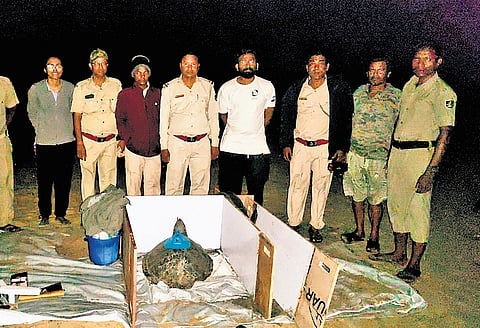

KENDRAPARA: A satellite-tagged Olive Ridley sea turtle has stopped transmitting signals since September after travelling for around 1,000 km from Gahirmatha Marine Sanctuary in Kendrapara district to the waters off Sri Lanka.
Senior scientist at Wildlife Institute of India (WII), Dehradun, Suresh Kumar said on Sunday, “We lost the signal from the turtle last month. In collaboration with the Odisha forest department, we had fitted satellite transmitters or Platform Transmitter Terminals (PTTs) on the carapaces of two female Olive Ridley turtles on March 12 during the mass nesting at Gahirmatha to track their migratory routes.”
Kumar said that the other tagged turtle had also stopped transmitting signals earlier in February after reaching the Sri Lankan coast. “We had been monitoring the movements of the turtles daily. Unfortunately, both transmitters stopped sending signals. When a transmitter stops signaling, it could be due to device malfunction, the turtle’s death, or the premature detachment of the tag. Such instances are fairly common in wildlife satellite-tracking studies,” he explained.
The scientist noted that ocean currents act like “highways in the sea”, which turtles skillfully use to navigate. “Olive Ridley turtles that arrive on the Odisha coast for mass nesting typically travel in the Bay of Bengal from Odisha to Sri Lanka. They never venture into the Pacific Ocean,” he added.
Wildlife biologist and officer-in-charge of Western Range Centre of Zoological Survey of India, Pune, Basudev Tripathy, recalled earlier tagging efforts. “In April 2001, the Odisha forest department and WII had first fitted four turtles with PTTs, allowing online monitoring of their movements. Only one of them migrated south towards Sri Lanka. In 2007, PTTs were again fitted on 30 turtles, and many of them were recorded moving towards Sri Lankan waters,” he said.
