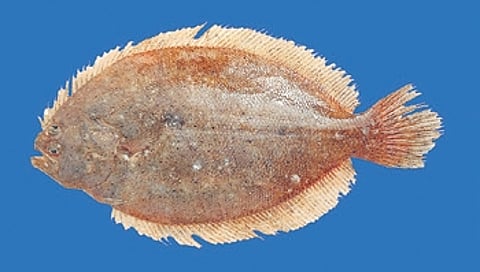

BERHAMPUR: A team of researchers from the Estuarine Biology Regional Centre of the Zoological Survey of India (ZSI) has discovered a new species of flounder from the Bahuda estuary in Ganjam district.
The newly-described species, Pseudorhombus bahudaensis, has been detailed in the study ‘Resolving the Pseudorhombus arsius cryptic species complex (Teleostei, Paralichthyidae): phylogenetic evidence and description of Pseudorhombus bahudaensis sp. nov’. The finding redefines the long-held understanding of the Gangetic largetooth flounder, Pseudorhombus arsius.
Member of the research team and one of the lead scientists Anil Mohapatra said the discovery exemplifies how integrating molecular data with classical taxonomy can uncover hidden evolutionary lineages that morphology alone cannot distinguish. “What was once thought to be a single species across the Indo-Pacific actually comprises multiple, genetically distinct lineages,” he said, noting that the research combined morphological, morphometric, and molecular analyses over the course of a year.
Using advanced DNA barcoding and phylogenetic tools, the team identified two major clades corresponding to P. arsius and the newly-described P. bahudaensis. The genetic divergence between them dates back roughly 17 million years, suggesting an ancient evolutionary split long masked by morphological similarities. Notably, the Bahuda lineage does not genetically match any P. arsius sequences available in global databases, underscoring its novelty and endemic nature.
The species was first found in Bahuda estuary along the Odisha-Andhra Pradesh border, and later observed in Gopalpur and Penthakata (Puri). Its discovery highlights the ecological importance of Bahuda estuary as a biodiversity hotspot within the western Bay of Bengal.
The discovery also has direct implications for fisheries management, as flounders are commercially valuable and accurate species identification is vital for sustainable exploitation and trade regulation. Ultimately, the study underscores India’s growing role in advancing marine biodiversity research.
The research team also included Smrutirekha Acharya, Rajesh Behera, Swarup Ranjan Mohanty, Dipanjan Ray, Shesdev Patro and Subhrendu Sekhar Mishra.
