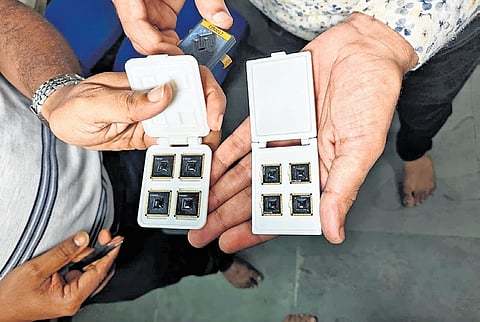

BHUBANESWAR: Three chips developed by Odisha-based institutions made it to the first batch of 20 Make-in-India designs presented to Prime Minister Narendra Modi during the SEMICON India-2025 conclave on Tuesday.
The chips include a multiplier integrated circuit (IC), sensor circuit and an advanced encryption core. The high-performance multiplier IC (C2S0061) has been designed by Parala Maharaja Engineering College in Berhampur while VG amplifier and sensor circuit (C2S0018) and present encryption core (C2S0017) have been developed by NIT-Rourkela.
The standout among the designs is the high performance multiplier IC, which can be used for criminal identification with face recognition and deep-learning application. With 31.9 per cent (pc) reduction in silicon area and 41 pc less power consumption compared to conventional multipliers, it offers a scalable solution for resource-constrained environments.
Fabricated at SCL, Chandigarh by using 180 nm CMOS baseline process technology, the chip will help track the criminals and recognise them in real time. The chip has been designed by junior research fellows Rashmita Karna, Pradeep Kumar Mohanty and Sasmita Padhy under the guidance of chief investigator Raghunandan Swain and co-chief investigator Dinesh Kumar Dash.
Among the two other ICs, the present encryption core is a lightweight block cipher, which is a type of cryptographic algorithm. It is ideal for internet of things (IoT), radio frequency identification (RFID), e-payments, healthcare and sensor network security. Guided by Ayas Kanta Swain and KK Mahapatra, the IC has been developed by NIT-Rourkela students Ruby Mishra and Bharat Patidar.
Similarly, the VG amplifier sensor circuit IC has been designed for biomedical and IoT applications. Designed by students Ipsita Dash, Samikshya Das and Prem Sai, this IC integrates a capacitive interface with accelerometer connectivity, operational trans-conductance amplifier components and energy harvesting mechanisms.
“The chips have been developed under the chip-to-startup (C2S) initiative. Equipped with advanced EDA tools, NIT-Rourkela has tied up with the fabrication facilities through SCL Chandigarh and CDAC Bangalore for the R&D and embedded system design,” said Swain.
Patidar said, “Designing these ICs has exposed us to real-world chip design challenges. With the anticipated growth of the semiconductor sector in Odisha, skilled graduates can play a key role in advancing IC design, manufacturing and fabrication.”
