
BHUBANESWAR: History has to be understood in the context in which it was written and not pulled out of the framework to be presented as ‘our history versus their history’, historian R Mahalakshmi said on Saturday.
Speaking during the session on ‘Reclaiming History: An Evolving Study’, she said, “What we read as historical sources has to be seen in a nuanced way. Whether it is a Veda, a Dharmashastra or a Purana, whatever the source, we have to examine the context in which it was written rather than extract something and present it as our history versus their history.”
“Let there be claims, but ultimately it is the historian who generates the historical narratives. So, first it should be the historian who is talking about what the narrative is and how to build that narrative, because there is a methodology on writing history,” Mahalakshmi said.
“When we say claims and reclaims, are we really talking about it from a historical perspective or are we bringing an ideological colour to this discussion?” she added.
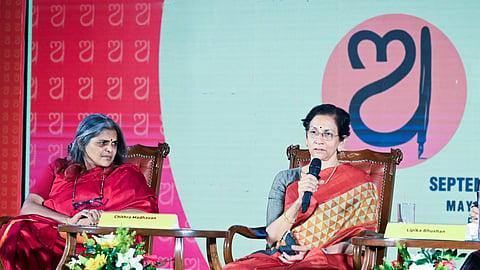
The discussion, which also featured historian Chitra Madhavan and was moderated by consultant and author Lipika Bhushan, explored how historical narratives are shaped, contested, and reinterpreted.
Mahalakshmi argued that those attempting to “reclaim” history often risk falling into the very colonial traps they seek to escape, by focusing narrowly on rulers and dynasties. Instead, she stressed, the focus should be on people, societies, and social structures.
Chitra agreed on the need for nuance, pointing out that while readers should engage with books and materials, they must avoid being swayed by their ideology. “Today we talk about individual histories of states, but in reality, they all came together. For instance, there’s a place near Puducherry where inscriptions from Odisha have been found. One of Raja Raja Chola’s consorts was from Gujarat,” she observed, highlighting the deep cultural inter-linkages.
“We also know that Konark temple, designed like a chariot, is one of the most beautiful examples of temple architecture. The renowned historian C Sivaramamurti once noted that a princess from the Chola country married a king of the Ganga dynasty of Kalinga, and with her came the tradition of building a chariot-shaped temple. This is how ideas travelled back and forth,” she added.
