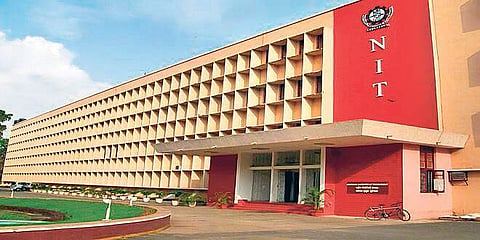

ROURKELA: A research team of the National Institute of Technology - Rourkela (NIT-R) has secured patent for an AI-enabled future-ready innovative model that optimises the VANETs system to effectively transmit important and time-sensitive alerts to vehicles for enhanced road safety and smooth navigation.
A self-organising wireless network, the VANET (Vehicular Ad Hoc Network), facilitates vehicle-to-vehicle interaction (V2V) with roadside infrastructure (V2I) to share real-time information for enhanced road safety, traffic management and navigation.
The patent is titled, ‘Adaptive Contention Window Optimisation in VANETs using Multi-Agent Deep Reinforcement Learning for Enhanced Performance Model’. The research team, comprising assistant professor Arun Kumar, Prof Bibhudatta Sahoo, and professor and research graduate Lopamudra Hota of the department of computer science & engineering, secured the patent after successfully integrating their AI model of multi-agent deep reinforcement learning with the VANETs.
In VANET concept, it is envisaged that while navigating, vehicles in close proximity would wirelessly communicate with one another and send necessary alerts, the researchers explained. “For instance, a car could warn other vehicles about its precipitous braking or a sudden obstacle on the road and such V2V communication would aid safe driving, automated traffic systems and even provide assistance to emergency services,” they added.
However, in a situation where multiple vehicles simultaneously send out messages, the system is bound to get overcrowded causing delayed or lost messages to ultimately compromise with its viability, the researchers said. Hence to overcome such challenges, their team at NIT-R have brought in a solution with their AI model.
In simple terms, the new model enables each vehicle to stagger the time of its messages depending on the actions of other vehicles. The vehicles system learns to sequence and give priority to messages that are important and time-sensitive. This adaptive adjustment reduces the chances of delay and helps ensure that important alerts are transmitted reliably even in crowded condition.
Prof Arun cited that in 2023, India had reported around 4.80 lakh road accidents and around 1.72 lakh deaths, many of which could have been prevented using modern technologies. “Our work is a step towards building safer roads and smarter cities. We envision a near future where autonomous vehicles become a reality in India, and this patent is a small step in that direction, driving the spirit of Innovate in India and Make in India,” he added.
VANETs are capable of obtaining, processing and providing instantaneous information to users on current traffic conditions of roads, improve emergency response systems by rapid broadcast of crucial information, support geolocation systems and make electronic payments to on-site utilities.
Prof Sahoo said the patent represents a practical step towards preparing India’s road system for V2V communication. “By addressing potential congestion in VANETs and providing a model for adoptive, coordinated communication, the findings lay the groundwork for safer and a more efficient traffic management,” he underlined.
