
Agriculture in India is not merely an occupation, it is a way of life, deeply woven into the fabric of rural society. At its heart stand women farmers, the invisible backbone of our agrarian economy. Nearly 80 per cent of rural women are engaged in agricultural work, forming about 40 per cent of the sector’s total workforce. Yet, despite contributing to more than two-third of all farming activities, women own barely 12.8 per cent of agricultural land.
As men increasingly migrate to urban areas, the “feminisation of agriculture” is reshaping the rural landscape. Women now manage farms, conserve seeds, process harvests, and market produce. Across the world, 36 per cent of working women are employed in agrifood systems. However, their productivity and recognition remain constrained by limited access to land, credit, training, and technology. As the Food and Agriculture Organization (FAO) has emphasised, providing women equal access to resources could close the gender gap in agricultural productivity and lift millions out of poverty.
The FAO’s recent report, The Unjust Climate, shows that female-headed farm households lose significantly more income to climate shocks than their male counterparts. As temperatures rise and extreme weather intensifies, these inequalities deepen. Women farmers face the brunt of climate variability while playing a critical role in ensuring food and nutritional security for their families and communities.
Recognising this, the UN General Assembly has declared 2026 as the International Year of the Woman Farmer, a global acknowledgment of their indispensable role in food systems, nutrition, and poverty eradication.
Guardians of Seeds and Soil
For centuries, women have nurtured a close relationship with the land. They are custodians of agrobiodiversity - selecting, conserving, and sharing seeds suited to local soils and climates. Their knowledge of indigenous crop varieties, wild edibles, and medicinal plants sustains food diversity and resilience. A UN Environment study found that women provide nearly 80 per cent of all wild vegetables gathered in traditional societies.
Women’s decisions on what to plant and preserve are guided not just by yield, but by taste, aroma, ritual value, and household needs - ensuring that biodiversity flourishes in both the field and the kitchen.
Odisha’s Women: Sustaining Heritage Through Seeds and Stories
Odisha offers powerful examples of women safeguarding agrobiodiversity and agricultural heritage. From the Paraja, Kondh and Gond communities to the paddy-rich plains of Koraput, women have preserved hundreds of traditional crop varieties through everyday practices.
In Nuapada and Balangir, women farmers conserve local pulses such as Kala Muga and DhabJhudunga, crops tied to rituals and regional cuisine. During Nuakhai, women prepare flattened rice with forest honey, symbolising harmony among nature, harvest and community. Their traditional recipes - Kardi Chutchuta, Mahul/Tol Pitha and Nim Phul Bhaja, etc., reflect deep ecological knowledge and cultural continuity.
Women as Seed Custodians
Under Odisha’s flagship Shree Anna Abhiyan, aligned with the International Year of Millets (2023), the government has formally recognised women’s role in conserving traditional crop diversity. The programme has facilitated registration of 29 millet landraces and eight pulse varieties under the Protection of Plant Varieties and Farmers’ Rights Authority (PPVFRA). Most of these have been conserved by women seed keepers who manage community seed banks and exchange indigenous varieties through informal networks.
The Koraput district, designated by the FAO as a Globally Important Agricultural Heritage System (GIAHS), epitomises this living legacy. Women farmers here have preserved traditional rice varieties for generations, reinforcing the region’s reputation as a secondary centre of paddy origin.
Gender-Friendly Mechanisation: Technology with Inclusion
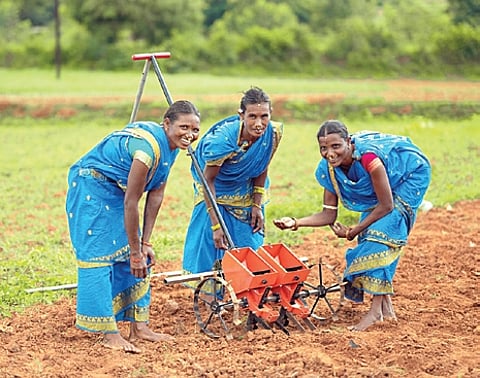
The dual trends of feminisation of agriculture and ageing of the farming population demand new thinking in mechanisation. Most farm equipment are still designed for men - heavy, oversized, and ergonomically unsuitable for women and elderly farmers. Unless addressed, this could widen gender gaps.
Odisha has pioneered a new approach through Participatory Machinery Development (PMD) under Shree Anna Abhiyan. The programme tests and customises farm tools for gender and age suitability. Women farmers participate in every stage - identifying problems, co-designing tools and field-testing prototypes. Implemented across Sundargarh, Keonjhar, Koraput, Nuapada and Gajapati, PMD has led to the creation of lighter, locally repairable equipment that reduces drudgery and increases efficiency.
More than machinery, PMD represents a shift in mindset by seeing women not just as beneficiaries but as co-creators of innovation.
Living Landscapes of Women’s Knowledge
Odisha’s Department of Agriculture & Farmers’ Empowerment (DA&FE), with support from the FAO, is documenting agrobiodiversity in the Gandhamardan and Mahendragiri hill ranges, both rich in medicinal plants, millets, pulses and wild edibles. Gandhamardan, often called a ‘living pharmacy’, hosts over 220 medicinal plant species and 40 resilient crop varieties, while Mahendragiri supports more than 1,800 plant species and 35 landraces.
Women in these landscapes balance farming with seed conservation, foraging and ecological restoration. Both regions were declared Biodiversity Heritage Sites in 2023, and conservation actions now integrate biodiversity protection,
community empowerment, and agri-ecotourism, with women’s leadership at the centre.
Women farmers of Odisha are far more than agricultural workers. They are knowledge bearers, biodiversity conservators and cultural stewards. By protecting seeds, cuisines and rituals, they keep alive the memory of crops that once nourished generations and the ecological wisdom needed to face the future.
As the world prepares to celebrate the International Year of the Woman Farmer (2026), Odisha’s women farmers offer a powerful model of what inclusive, resilient and sustainable agriculture can look like, rooted in diversity, tradition and dignity.
Recognising and empowering them is not only a tribute to their labour but an investment in the sustainability of our food systems and the cultural soul of our nation.
(The author is principal secretary, Agriculture & Farmers’ Empowerment, Government of Odisha. The views are his own)
