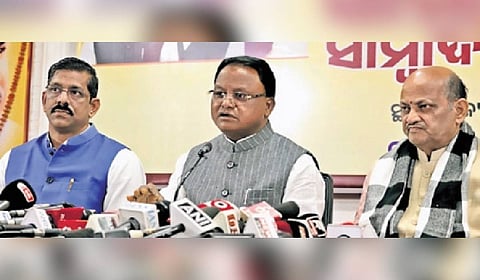

BHUBANESWAR: Chief Minister Mohan Charan Majhi on Tuesday launched a scathing attack on the previous Congress-led UPA government’s handling of the rural employment programme MGNREGA, alleging that the former scheme was riddled with corruption, administrative failures and structural weaknesses.
Addressing a press conference at the state BJP headquarters for the first time, the chief minister said the newly-enacted Viksit Bharat Guarantee for Rozgar and Ajeebika Mission-Gramin (VB-G RAM-G) Act is far more practical, technology-driven and result-oriented. It aims to realise Viksit Bharat by 2027 and and fulfil Mahatma Gandhi’s vision of true Gram Swaraj through sustainable livelihood generation.
“Previous attempts at rural employment before and after Independence failed due to lack of vision, weak decentralisation, administrative lapses and widespread corruption. The UPA-era MGNREGA, despite its noble intent, degenerated into a corruption-prone system with widespread irregularities across states,” he said.
He cited large-scale corruption during the UPA regime, including alleged scams of `6,000 crore in Bihar and `10,000 crore in Uttar Pradesh, adding that Odisha too faced serious misuse of funds. In Sambalpur (in 2012), wages were allegedly drawn in the names of deceased persons, patients and pension beneficiaries. Fake muster rolls, unfinished road projects and fraudulent wage payments were rampant, Majhi said.
The chief minister said while MGNREGA promised 100 days of employment, workers on ground received barely 50 days, with meagre wages and frequent payment delays. Seasonal agricultural realities were ignored, leading to labour shortages during sowing and harvesting, hurting farmers.
“These structural flaws made MGNREGA ineffective, corruption-prone and disconnected from real rural needs,” he asserted.
The new Act, Majhi said, corrects these weaknesses through a dynamic, technology-backed framework. Employment entitlement has been raised from 100 to 125 days per family, while strict timelines mandate unemployment allowance if work is not provided within 15 days of demand. To protect farmers, the programme will remain suspended for up to 60 days annually during sowing and harvesting seasons, preventing labour shortages and artificial wage inflation in agriculture.
He said the new Act integrates AI, GPS and mobile-based monitoring to ensure transparency and eliminate fake works and ghost beneficiaries. Four priority areas - water conservation, rural infrastructure, livelihood generation and climate resilience - have been identified to create durable assets and sustainable incomes.
“This law is not symbolic. It is practical, farmer-friendly and corruption-proof,” Majhi said and added that funding responsibility shared between the Centre and states will strengthen accountability and coordination.
State BJP president Manmohan Samal, ministers Rabi Narayan Naik, Mukesh Mahaling, Nityananda Gond and other senior leaders were present.