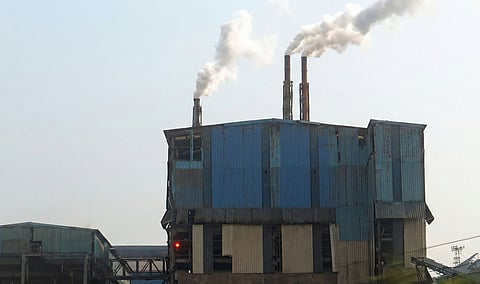

SAMBALPUR: Amid growing concerns over pollution, the air quality in Rengali Industrial area of Sambalpur has become a cause of concern with the average PM10 (particulate matter less than 10 micrometres) standing at 418 micrograms per cubic metre in the recent times.
This indicates that the Air Quality Index (AQI) has crossed 300, placing the region in the ‘very unhealthy’ category. Disturbingly, this deterioration has occurred in the absence of any government-installed air quality monitoring system, leaving residents largely unaware of the scale of the health risk they face.
Rengali block hosts eight large industries along with several small-scale units including four rice mills and around 20 stone crushers. The region also houses two major mines, Talabira Coal Mine Phase I and II. Adding to the pollution load, around 4,000 to 5,000 heavy vehicles ply daily on Rengali road. Within this limited geographical area, the density of pollution-generating units far exceeds permissible capacity.
As per norms, PM10 levels should not exceed 100 micrograms per cubic metre. However, current readings in Rengali are more than four times the prescribed limit. While several cities in Odisha including Bhubaneswar, Cuttack, Rourkela besides neighbouring industrial towns of Brajrajnagar and Angul are equipped with automated air quality monitoring stations, Sambalpur district lacks such facilities. Within Sambalpur city, only manual monitoring is conducted at three locations including Modipada, Bareipali and Daleipara, while Rengali has none at all.
The issue was earlier raised in the state Assembly by BJP when it was in the opposition, seeking installation of pollution monitoring systems in Rengali. However, after the party came to power in 2024, no concrete step has been taken in this regard. Though large industries are mandated to install pollution monitoring mechanisms, there is no public access to such data, leaving residents without verified information to raise informed demands.
Prominent residents of the area say air quality monitoring stations cost `1-2 crore, and procurement is possible through DMF funding.
Sambalpur collector Siddheshwar Baliram Bondar could not be reached for his comment on the issue.