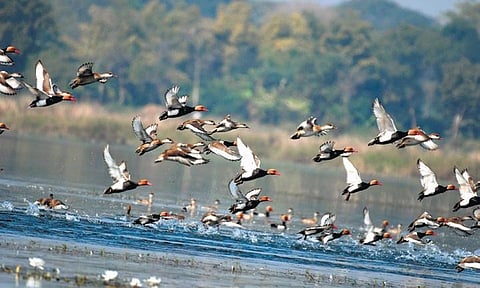

SAMBALPUR: The Hirakud wetland has emerged as a thriving winter refuge for avian guests yet again, with the 2026 bird census recording a sharp rise in both population and species diversity.
The annual mid-winter waterfowl census conducted on January 18 recorded a whopping 4,21,763 birds across 128 species, marking a significant increase from 3,77,732 birds and 122 species in 2025. The upward trend has been consistent over the last three years, with 3.4 lakh birds recorded in 2024 and 3.16 in 2023, clearly indicating improved habitat conditions in and around the reservoir.
During this year’s enumeration, forest officials also spotted five bird species not recorded in the last three years. These are ruddy crake, greater painted snipe, painted stork, little gull and sanderling. Among other migratory waterfowl, tufted duck emerged as the most abundant species with over 71,000 birds, followed by lesser whistling duck (60,987) and common coot (51,665).
The census covered the entire Hirakud reservoir and power channel, a area of around 550 sq km divided into 21 sectors. The highest bird congregation was recorded in upstream areas near the Odisha-Chhattisgarh border. Sector 8 topped the list with more than 72,500 birds and 68 species, followed by Sector 7 and Sector 9.
Divisional forest officer (DFO) Anshu Pragyan Das attributed the rise to sustained conservation efforts and favourable habitat conditions. “The consistent increase in bird numbers over the years shows that Hirakud wetland is becoming safer and more suitable for migratory species. Submerged islands, rich aquatic biodiversity, availability of sandbars and reduced disturbance have played a key role in attracting birds in large numbers,” she said.
A total of 38 teams with 93 participants, including bird experts and forest staff from Sambalpur, Jharsuguda and Bargarh districts, took part in the census using GPS-based route mapping to avoid overlap.
