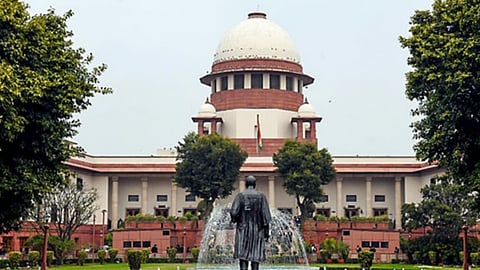

NEW DELHI: Taking strong exception to Odisha courts’ orders directing certain accused persons - especially Dalits and Adivasis - to clean police stations in lieu of bail, the Supreme Court on Monday severely criticised these orders after finding those as obnoxious and reflecting caste-based bias.
“We are deeply disappointed and disheartened and express our strong disapproval at the way Odisha judiciary has expressed regressive mindset which is ex facie violative of human rights which strike at the dignity of the accused,” said the bench of Chief Justice of India (CJI) Surya Kant and Justice Joymalya Bagchi, adding that such orders are violative of human rights and strike at the dignity of individuals.
The top court took the order as a suo motu case after various news reports flagged such bail conditions imposed by courts in Odisha.
“We are of the considered opinion that any other State judiciary shall not use such conditions of caste colour which can generate social friction. Thus, let this order be made available to all judicial officers across the country not to impose such conditions,” the bench said.
The top court in its order said that there were statedly at least six more such orders that have been passed by trial courts in Odisha during the period between May 2025 and January 2026, imposing similar unpalatable conditions.
“It has been widely reported that such conditions reflect an underlying, albeit unarticulated, bias of the Odisha State Judiciary, premised on the perception that the accused individuals, belonging to marginalised Adivasi communities and, therefore, it may be justified to subject them to such burdensome requirements. This unfortunate condition, in fact, is founded upon the presumption of guilt of the accused, as in a way, a nature of sentence has been awarded to them,” the court said.
It went on to declare the conditions as null and void, after expressing strong disapproval of the Odisha judiciary’s “regressive mindset”. “Such conditions are ex facie a violation of human rights and strike at the dignity of the accused. Such orders exposed caste bias against marginalised communities,” the court said.
The bench also stressed that courts should refrain from imposing conditions that have a caste bias and could cause social friction. “The nature of the conditions is so cruel and abhorrent that it has the capacity to project the Odisha judiciary as caste-biased. The judiciary is expected to protect such rights. In 75 years of constitutional journey, the judiciary has ensured that the might of the state cannot undermine the rights of the people,” the bench said.
Granting liberty to the accused persons to approach the high court to delete such conditions, the bench in its order stated, let the petitioners approach the Orissa High Court to forthwith delete such conditions and not substitute it with any other analogous condition. The accused shall remain on bail.
The SC noted the controversy arose out of protests over land acquisition for a bauxite mining project in Rayagada and Kalahandi districts by Vedanta Group but maintained that it was not concerned, in the present case, with the legality of the land acquisition or the veracity of the FIRs registered.
