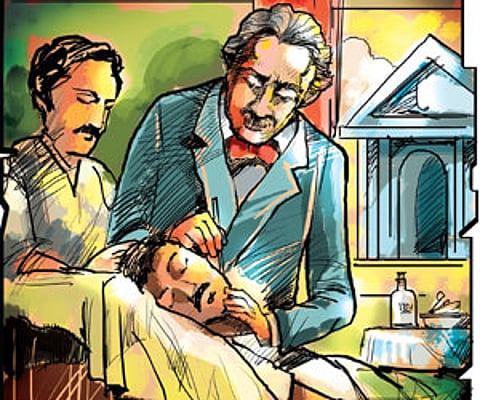

The first medical school among the overseas French colonies was in Pondichéry in the 19th century, aligning with the colonial expansion of the French. French scientists were revolutionising medicine: René Théophile Hyacinthe Laënnec (1781–1826) designed the stethoscope in 1816 and published its science in 1819, Jean Baptiste Cruveilhier (1791-1874) contributed significantly to pathological anatomy, and the microbiological work of Louis Pasteur (1828–1895) established the microbial cause of diseases. However, a western-medicine practicing hospital was set up in Ozhukarai (Oulgaret), a village near Pondichéry town, much earlier in 1742.
L’École Médecin de Pondichéry (l’ÉMP; the Medical School of Pondichéry) was established by Governor Napoléon Joseph Louis Bontemps in 1863, under the leadership of Docteur Beaujean, who taught medicine and surgery. Docteur Huillet taught anatomy and minor surgical procedures. The school trained Indian men and women in becoming doctors, midwives, health inspectors, and vaccinators. Students of medicine, whose numbers grew from five at the start to 50 in later years, studied for five years. Medical curriculum at the Medical School of Pondichéry corresponded to that offered in France and was governed by the rules of Bureau de Santé Français (French Health Office) in Paris. Training of health inspectors ceased in 1892.
The Dictionnaire encyclopedique des sciences medicales (1864 –1889) elaborately refers to several medical procedures (e.g., forensic procedures, treatment of beriberi and cholera) carried out by Docteurs Beaujean and Huillet at l’ÉMP.
Health Management in French territories in India, including Pondichéry, expanded in subsequent years with the organisation of four hospitals, one prison-health service, one leprosy asylum, and 13 free clinics. Only those students who successfully completed their five-year medical study could practice. Paramananda Mariadassou (Mariadas-u in spoken Tamizh) was the first docteur médecin (doctor of medicine) graduate of l’ÉMP. With the incorporation of Pondichéry and other French territories with the Indian Republic in 1954, the school became the Pondichéry Medical College & Hospital, which, in recent times, has been renamed as Jawaharlal Institute of Postgraduate Medical Education & Research (JIPMER).
Mariadassou (1870–1947) contributed significantly to public health, while practicing in French territories located in the modern state of Tamil Nadu. He was a physician attached to the Karaikal Hospital. He wrote the following books: Moeurs medicales de I’lnde et leurs rapports avec la médecine européenne (Medical ethics of India and their relationships with those of European medicine) (1906, 178 pages, M.P., Pondichéry) and Médecine traditionnelle de I’Inde: (Traditional medicine of India) (1934–1936; 4 volumes, Saint-Anne Press, Pondichéry).
Albert Calmette (1863–1933), a popular French physician, bacteriologist, immunologist and a colleague of Louis Pasteur, passionately refers to Mariadassou’s treatment of snakebites in his book Venoms, venomous animals, and antivenomous serum (English translation by E E Austen, 1908, Bale & Danielson, London). Calmette alludes to Mariadassou’s successful treatment of two patients with bites of poisonous snakes in Karaikal Hospital in 1901, using Calmette’s serum (the antivenin developed by Albert Calmette in 1894 using immune sera from vaccinated horses).
Mariadassou seems to have taught Indian medicine as well; his book Le rejeunissement par le kayacarpam (Rejuvenation by kayakarpam) (1938, Pondichéry) is an evidence of his interest (and mastery-?) over Indian medicine. He published another book Le jardin des simples de l’Inde (The simple Indian garden) (1913, 274 pages, Mission Press, Pondichéry), which probably includes details of the pharmacognostic properties of Indian plants.
(The author is a senior lecturer in Ecological Agriculture at Charles Sturt University, Orange, New South Wales, Australia)
