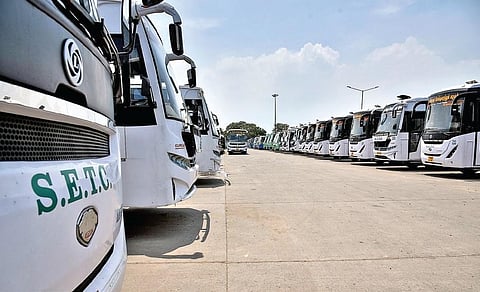

CHENNAI: The State government is planning to bring in private participation in running State Transport undertakings (STUs) under which procurement, operation and maintenance of buses will be carried out by external entities through Gross Contract (GCC) or public-private partnership model, says a policy note tabled by the transport department in Tamil Nadu Assembly on Thursday.
The responsibility of managing transport network and revenue collection, however, will remain with the STUs, the note said. The move comes against the backdrop of STUs reporting a revenue shortfall of `6,488 crore in financial year 2021-2022.
According to the note, the STUs will be responsible for providing quality service to commuters and they will also specify the minimum distance that has to be covered every day by private operators who will be paid on a per-km basis. The main advantage of the GCC is reduction of large upfront capital expenditure in procuring buses and reduction of cost in maintaining an inventory of spares and other consumables, the note said. The salary cost of maintenance staff can be reduced and STUs can also ensure considerable saving and enhanced level of efficiency throughout the contract period, the note said.
The STUs, however, should maintain a minimum number of own buses with enough staff for use in case of emergencies, said the note. Interestingly, this model has been tried in Delhi Integrated Multimodal Transit System (DIMTS) where buses were hired from a concessionaire. The move help reduce cost of operating buses by 30%-50% in the capital. Even in Ahmedabad, 70 specially-designed diesel buses were provided to private operators on GCC basis for seven years.
‘Largest electric bus tender awarded on GCC basis’
Sivasubramaniam Jayaraman, National Lead-Electric Mobility and Transport Systems, Senior Programme Manager, Institute for Transportation and Development Policy, said the government is taking progressive steps and exploring innovative models for operating buses in TN. GCC is a globally popular model. Cities like Delhi, Mumbai, Pune, and Ahmadabad are operating buses on GCC moder,” he said.
“Recently world’s largest electric bus tender for 5,000 buses was awarded on the basis of GCC model. For the model to succeed, the agreement should take care of service-level benchmarks and include penalties in case of not being able to conform to the standards fixed in the agreement. The contract should also incentivize the service provider for performing well,” he said.
The government should also explain to the people on why they are going for this model, he added. Shreya Gadepalli, noted transport expert and managing trustee of the UrbanWorks Institute, said, “STUs can now focus their energy on better service planning and citizen engagement, while leaving the grunt work of bus operations and maintenance to private sector.
STUs must establish clear performance indicators and use IT tools to ensure citizens get reliable and comfortable bus services.” Former Anna University professor of urban engineering K P Subramanian said the model is fine if fare is not increased and there is no further dip in ridership. He said the government should also ensure that social objectives like free bus ride for women and bus passes for schoolchildren are not compromised.
The STUs served about 70 lakh people every day in 2020- 2021 during the Covid-19 pandemic. The patronage increased to 1.21 crore per day in 2021-2022, and after relaxation of restrictions in March-2022, the ridership has increased to 1.55 crore per day.