
CHENNAI: It was Friday morning. With only two weeks left for the Lok Sabha election, a booth-level campaign office of a major party in Maduravoyal, coming under Sriperumbudur constituency, was bustling with activity. “It is at the booth-level that the real fight happens,” said Thirumaran (name changed), who is in charge of the office.
Around eight to 13 people are at his command at any given time. “Our work involves mobilising people for the campaign when candidates or key leaders visit nearby areas, advertising on walls, carrying out campaigns independently, verifying voters lists etc,” he said.
According to him, the daily expenditure at the booth office is around Rs 15,000 and it goes up as the polling day nears. Food for party workers, transportation, mobilising crowds and advertising constitute key expenses. “I know for a fact that it goes up to Rs 40,000 to Rs 50,000 in constituencies where heavyweights are in the fray,” he added.
With major parties having 1,500 to 1,700 booth committees in a parliamentary constituency, an estimate of Rs 10,000 per day per booth would result in a total expenditure of a whopping Rs 30 crore for 20 days.
A functionary in Arakkonam constituency said his party’s candidate had given Rs 10,000 for the party unit in each village for painting party symbols on walls. This translates to Rs 49.5 lakh for the 495 villages in the constituency, which is more than 50% of the Election Commission of India’s expenditure limit of Rs 95 lakh per candidate in Tamil Nadu. “In some villages where there is no partyman, residents have been paid Rs 2,000 to Rs 3,000 for renting out their walls to draw poll symbols,” he added.
TNIE visited multiple polling booths in Arakkonam, Sriperumbudur and Kancheepuram constituencies and found similar expenditure patterns by the major parties, which fly in the face of expenditure limits and monitoring mechanisms put in place by the ECI.
Besides expenses that are directly accounted against each candidate, political parties are allowed to spend for their party’s campaign. Expenses such as mobilising people for junction or street-level campaigns, organising major meetings, and road shows are not accounted for in the daily operational costs of the booth committees, clarified a senior office bearer of a party.
According to the affidavits presented to the EC, the DMK spent Rs 79.26 crore during the 2019 election, while AIADMK reported expenditures of only Rs 20.9 crore. Similarly, during the 2021 Assembly elections in Tamil Nadu and Puducherry, the DMK declared Rs 114.14 crore expenditure, whereas the AIADMK spent Rs 57.33 crore.
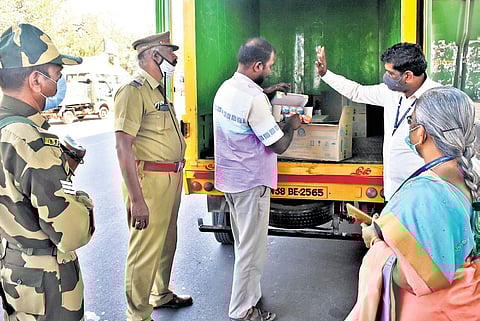
The effectiveness of multiple teams of flying squads, static surveillance teams, video surveillance teams, and expenditure observers seemed to be limited for political parties while the brunt appeared to be borne largely by small traders, cattle farmers and the general public.
Sample this: N Porkodi, a resident of Ambattur recalled a recent instance where she was stopped by monitoring teams.
“I withdrew Rs 1 lakh from the bank for paying towards school fees. I was stopped at Ambattur junction, and only after presenting my withdrawal receipt that I was allowed to proceed. The next day, we had to pay the remaining Rs 5 lakh in cash at the school. We were afraid of using a bike or a car as we may be stopped. Hence, my husband and I walked 2.5 km,” she said.
As of April 6, Rs 192 crore worth cash and other materials were seized in Tamil Nadu, of which a considerable amount had been returned, indicating the ineffectiveness of the mechanism to control the expenditure by political parties.
In 2019, a total of Rs 952 crore worth of cash, jewellery, liquor, and other items were seized, of which gold alone amounted to Rs 709.67 crore. Except liquor and contraband items, all seized cash and jewellery were returned to their owners within a few days. The Income Tax and Enforcement Directorate held inquiries in connection with the seizure of Rs 11.5 crore from the places allegedly associated with the DMK candidate in Vellore.
P Joseph Victor Raj, coordinator of Association for Democratic Reforms (National Election Watch) TN said, “A robust legal framework to tackle the menace of money power in elections is important. This includes stringent enforcement of existing laws and possibly introducing new legislation. The expenditure limits need to be revisited.”
An EC official said, “The expenditure observers are actively monitoring the campaign and regularly submitting reports to the ECI. We have put in the existing monitoring system to track the flow of money. Any further improvements should be decided by the ECI.”
Rs 192 cr
worth cash and other valuables were seized in Tamil Nadu. Out of the total valuables, a considerable amount had been returned to respective owners, indicating the ineffectiveness of the mechanism to control the expenditure by political parties
Rs 952 cr
worth cash, jewellery, liquor, were seized in 2019. Gold alone amounted to `709.67 crore. Except liquor and contraband items, all seized cash and jewellery were returned to their owners within a few days of the seizure