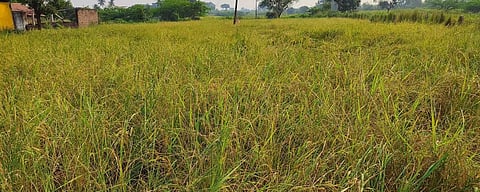

DHARMAPURI: The Soil Testing Laboratory in Dharmapuri is promoting a scientific approach to farming by analysing the soil and recommending supplements to improve soil health.
By identifying the shortcomings and rectifying the imbalance in the soil, the productivity of the soil will improve. However, despite the massive awareness on the usefulness of the Soil Testing Lab, farmers seldom avail of this service.
Speaking to TNIE about the benefits of soil testing, Tamilparthi, Agriculture Officer, told TNIE, "The soil testing laboratory looks into the 12 health indicators of the soil — the level of nitrogen, phosphorous, potassium, zinc, iron, copper, manganese, boron, acidity, organic carbon and electrical conductivity in the soil.
Globally studies have indicated that these are common compounds in soil and they must be in a particular ratio for good soil health. So we collect samples from farms and check if these levels are permissible. Following this we issue a Soil Health Card (SHC), in which we recommend the amount of fertilisers needed for the required crop.
Further, we issue recommendations for any crop to keep the 12 indicators balanced. Each crop would require different nutrients to thrive. Similarly, water testing is also conducted."
According to data from the Agriculture Department, between 2019 and 2024, a total of 73,999 people conducted soil testing and 37,971 people conducted water sample testing. While the district has over 2.10 lakh farmers, the number of farmers interested in this is low.
Speaking to TNIE, J Prathapan, Tamil Nadu Agriculturist Laborers Association said, "Soil testing or water testing has not been undertaken by farmers mostly because of circumstances and lack of technical knowledge among farmers. The district has over 1.90 lakh small-scale farmers and they find the process tedious. The soil testing can only be conducted before or after harvest.
However, circumstances do not allow these farmers to do such testing. Immediately after a harvest in most cases, they would go out of the district to work as labourers or engage in other works. Further, they do not find it convenient to take a day off and go to Dharmapuri and avail such testing methods. Instead, they would focus on earning income by other means. So we cannot blame anyone. Increasing the testing through mobile units could make the process convenient for farmers. Further, the lack of technical understanding could also be a factor."
Joint Director of Agriculture, V Gunasekaran, said, "In 2024- 25, the Union government announced the Soil Health and Fertility Scheme and set a target for soil testing in 8,500 places. So far we have collected 6,998 samples and over 3,626 samples have been tested and the remaining will be completed soon. To undertake soil testing, farmers only need to pay `30. Our officers would arrive and collect the soil samples. In three days the health card will be issued detailing the health of the soil. Further farmers only need to submit an application and our staff would collect samples and other procedures. Farmers won't be inconvenienced by the process."
How is soil testing conducted?
1. Field survey: A visual inspection to determine the appearance, texture, colour, erosion and other soil characteristics.
2. Collection of Samples: The soil samples are collected from a V-shaped slit dug on the top layer of the soil. Over five samples are collected for every acre.
3. Mixing of samples: The total samples collected are mixed and through the process of 'quartering' a large portion of the sample is eliminated and the final portion is taken.
4. Labelling: The collected sample is stored in cloth bags and labelled with the position and name of the farmer. This is then taken to the lab for analysis which would take up to three days.
5: Soil Health Card: A detailed report of the soil composition is given indicating the 12 health indicators and in case of any imbalance, recommendations of fertilizer and its amount along with crop recommendations are given.
