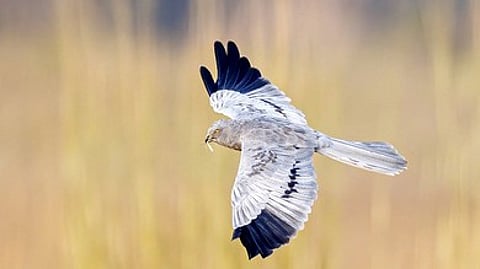

THOOTHUKUDI: The arrival of migratory Harriers, the raptor birds, to Thamirabarani river basin has witnessed a gradual decline due to the destruction of their habitats in the grasslands of the river basin. According to researchers associated with the Ashoka Trust for Research in Ecology and the Environment (ATREE), the development of housing plots in the grasslands, industries, windmills and increasing stone quarries have adversely affected the birds' habitat in the basin.
Harriers, which are ground roosting birds hailing from Eurasian countries, visit the grasslands of Vagaikulam, Peroorani, Vallanadu and Vanchi Maniyachi in Thoothukudi, Koonthankulam, Vijayanarayanam and Paruthipadu in Nanguneri, and Samugarangapuram in Radhapuram region during the migratory season (September and March). Though there are 16 different Harrier species, only three species — Montagu's harrier (circus pygargus), pallid harrier (circus macrourus) and Eurasian marsh harrier (circus aeruginosus) — visit the southern parts of Tamil Nadu.
According to ATREE researchers, these raptors prey on grasshoppers, birds, and rodents; whereas jungle cats, small indian foxes and dogs are their major predators. The typical character of the Harriers is to wait nearly 100m away from the roosting site to check for any disturbance before they roost, said M Mathivanan, coordinator, ATREE.
Speaking to TNIE, ATREE research associate A Saravanan said that the developing housing plots on grasslands, industries, windmills and the increasing stone quarries have adversely affected the birds' habitat. "We could not find large roosts of Harriers at the Paruthipadu grassland after eucalyptus trees were cultivated in the landscape," he said.
Moreover, an annual census conducted by the ATREE researchers recorded only 91 Harriers during a survey in 2022-23. "Previous census results have also shown a declining trend in the sighting of Harriers with 398 in 2015-16, 276 in 2016-17, 387 in 2017-18, 198 in 2018-19, 212 in 2019-20, 217 in 2020-21 and 201 in 2021-22," Saravanan added. It may be noted that over 70 and 91 stone quarries are active in Thoothukudi and Tirunelveli, respectively.
The State of India’s Birds Report (2023) had also noted that grassland birds are declining rapidly in India, said M Mathivanan, coordinator, ATREE. "Our researchers had tagged transmitters on 15 Harriers in India, including six from Tamil Nadu, to learn more about its routes. The bird tagged at Tharuvai in Tirunelveli a few years ago had returned to the same place again this year, and frequents Tharuvai and Panayankulam surroundings," Mathivanan added.
ATREE's senior scientist Dr T Ganesh told TNIE that the arrival of Harriers have declined all over India may be due to the loss of their habitats. "Their habitats on the grasslands have been encroached by the green energy projects such as solar farms that spread across hundreds of acres, wind mill turbines, and expansion of residential colonies into grasslands. If they find their habitat encroached by any other projects they would skip visiting the next season," he pointed out.
Though female Pied Harriers (circus melanoleucos) are rare visitors to the Thamirabarani basin, they were recently sighted at Vallanadu grasslands, said Sakthi Manickam, a bird watcher.
