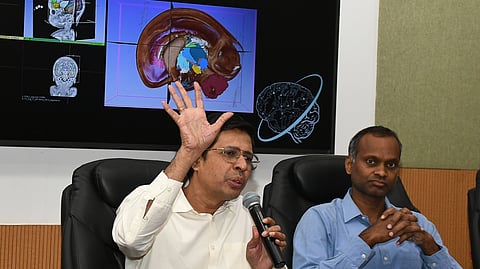

CHENNAI: The Indian Institute of Technology-Madras has achieved a rare feat in the field of brain mapping technology by releasing 3D high resolution images of human foetal brain on Tuesday. IIT-M director V Kamakoti claimed that such images are being released for the first in the world and the achievement is also special as such advanced human neuroscience data has been produced for the first time in India.
As many as 5,132 brain sections were digitally imaged at cell resolution level using cutting-edge brain mapping technology developed by the team at Sudha Gopalakrishnan Brain Centre at IIT. The high-resolution foetal brain images will have significant applications in enhancing current foetal imaging techniques and have the potential to enable early diagnosis and treatment of health conditions affecting the brain, Kamakoti said.
The image dataset, named ‘DHARANI,’ is now the largest publicly accessible digital dataset of the human foetal brain and is freely available to researchers worldwide.
The dataset provides detailed insights into brain development from the second trimester of a foetus and researchers have identified over 500 brain regions, making it a complete atlas of the human brain. The findings of this research have been accepted for publication as a special issue in the Journal of Comparative Neurology, a century-old peer-reviewed systems neuroscience journal.
Suzana Herculano-Houzel, Editor-in-Chief of the Journal of Comparative Neurology, said, “DHARANI is now the largest publicly accessible digital dataset of the human foetal brain, created with less than one-tenth of the initial funds that powered the Allen Brain Atlas, and with a technology platform that was entirely custom-made in India between 2020 and 2022 during the Covid-19 pandemic. IIT-Madras, thus, joins the Allen Brain Institute, and India joins the US at the table of human brain cartography where large sums are invested to provide mankind with freely available atlases of the knowledge about the structures that compose the human brain.”
Kamakoti said that since equipment required for this high-end research were not readily available, they were indigenously developed in collaboration with several public-private entities.
Sudha Gopalakrishnan Brain Centre, in just two years, has acquired over 200 brains of different types, ages (foetal, neonate, young adult, adult, old age) and affected by diseases (stroke, dementia) from various medical institutions in the country, and is processing them into cellular resolution digital volumes through its high-throughput imaging platform. The centre has developed a world-class high-throughput histology pipeline that processes whole human brains into high-resolution digital images at petabyte-scale.
The research was undertaken by a multidisciplinary team at IIT-Madras, with researchers from India, Australia, US, Romania, and South Africa, and in medical collaboration with Chennai-based Mediscan Systems and Saveetha Medical College Hospital.
The work has been supported by the office of the principal scientific adviser to the Government of India, Kris Gopalakrishnan, IIT-Madras alumnus and co-founder of Infosys, Premji Invest, Fortis Healthcare, Agilus Diagnostics, and NVIDIA, a leading AI company which partnered with the centre to help process these petabytes of brain data.
Mohanasankar Sivaprakasam, head of the Brain Centre at IIT-M, said, “This study will pave the way for new scientific discoveries, allowing quantification of neurodevelopmental disorders and advances in foetal medicine. This is now the largest publicly accessible digital dataset of the human foetal brain, advancing current knowledge by 20X.”
