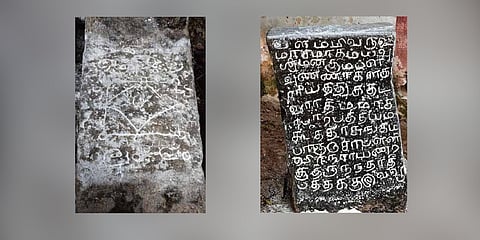

TIRUPPUR: A team from Virarajendran archaeological and historical research centre found Grantha and Tamil Inscriptions on stones, believed to be from to 11 and 16th centuries respectively in two temples at Pazhanchervazhi village in Kangeyam recently. The team was led by director of the centre S Ravikumar and included members K Ponnusamy and S Sadhasivam.
Speaking to TNIE, Ravikumar said, “Renovation work was carried out in the two temples for the past several weeks. A temple committee member P Thangamuthu informed us about unearthing stone slabs in the Siva temple. One slab measuring 220 cm in height, 50 cm in width and 20 cm thickness was found in front of the amman shrine.”
“It had inscriptions on all its four sides. The front side has two lamps, trishul, conch and moon symbols. The grantha inscriptions were read by eminent historian Prof Dr Y Subbarayalu and he said the slab featured words Hrim, Hushta, Hushra, Sham and Lam inscribed in many places. These denote that the stone is a mantra stone and people used it to curing diseases. Based on the letter style, he said the Grantha stone belongs to 11th century AD.”
The second stone bearing Tamil Inscription was found inside the Vishnu temple. It measured 80 cm in height, 50 cm in width and 20 cm thickness. It had inscriptions on its three sides. It highlighted the importance given to potters at that time past.
“The inscription stated that on the 18th day of Tamil month Masi in Vilimpiya year (Tamil calendar), the village was governed by Sri Maan Kuppal Annarkal, a chieftain. A potter named Kuthar Sungam donated four rupees to lit lamps in the Vishnu temple. It is interesting to find that four rupees was levied as tax. Based on the style of the Inscription, we fixed the date to 16th century,” he said.
