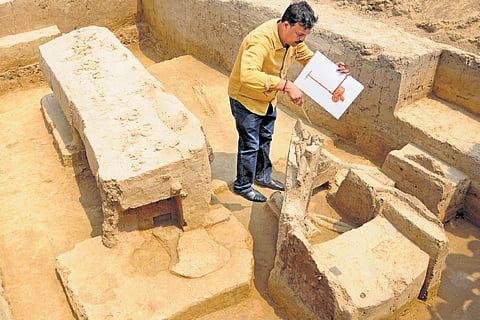

One of the defining moments in the history of India is the discovery and subsequent announcement of the Indus Valley Civilisation. On September 20, 1924, Sir John Marshall, a 48-year-old archaeologist with 22 years of experience as the Director-General of the Archaeological Survey of India, announced the discovery of the IVC in The Illustrated London News to the world. It would not be an exaggeration to state that his announcement restored more than three thousand years of ‘missing’ Indian history, in a single stroke.
Marshall’s excitement was evident in his words, “Our knowledge of Indian antiquities has up to the present taken us back no more than 2,500 years. Now, in a single bound, we have doubled that period and found that 5,000 years ago, the people of Sind and Panjab were living in well-made cities.”
The newly found civilisation was unique in several aspects, such as the uniform layout of the cities, the standard size of bricks, weights and measures, presence of female figurines (which Marshall termed as Mother Goddess), numerous seals and sealings featuring a uniform script, and the absence of any religious structures.
The prevailing notion at the time was that Indian culture was indeed ‘inaugurated by followers of the Rigveda’ and it was an article of uncontested faith. Hence, Marshall’s announcement struck down like a thunderbolt.
Marshall meticulously drew attention to the contrast between the Indus Valley Civilisation and Rigvedic culture, and argued against the possibility of a Vedic age preceding the Chalcolithic civilisation. Nayanjot Lahiri describes the personality of John Marshall to be having ‘a bit of Sherlock Holmes’ and the analogy is quite appropriate. It required the inquisitive and liberal mind of Marshall to take cognisance of a material culture that was distinct from anything previously known and the implications of its discovery.

Hundred years have passed since its discovery, and yet, IVC remains an enigma, as the reasons for its decline are still not known. Although, there are speculative research findings, we still have not deciphered the IVC script and we do not precisely know about the language or languages spoken there.
Some scholars have endorsed the view that IVC belongs to the Dravidians, while some others have argued that it is an Indo-Aryan civilisation. However, recent DNA-based findings push the enigma towards a Dravidian resolution. Among the early proponents of the Dravidian hypothesis was Sunithi Kumar Chatterji. As soon as Marshall made his announcement, Chatterji presented his ideas in the article ‘Dravidian origins and beginnings of Indian civilisation’ in Modern Review (1924). He compared the Indus Valley Civilisation with the excavations in Adichanallur and also outrightly rejected the possibility of an Indo-European and Sumerian origin. Then came along Father Henry Heras, who was also an early advocate of the Dravidian hypothesis.
Two other important scholars who contributed to the Dravidian hypothesis are Asko Parpola from Finland and Iravatham Mahadevan from India. Both of them took different approaches in their research. Asko Parpola studied particular symbols and signs such as the fish sign, bangle sign and the wild ass symbol, while Mahadevan took the direction of a bilingual analysis of the Indus script. He was the first one to publish a concordance for Indus scripts in 1977. Subsequently, he interpreted several signs of IVC and presented papers in several forums. Mahadevan’s concordance (IM77) has been digitised by the Indus Research Centre (IRC) of the Roja Muthiah Research Library and hosted online at indusscript.in.
As a conclusive decipherment of the Indus script still remains elusive, particularly in the absence of a Rosetta Stone-type bilingual aid, I decided to follow a different approach, to compare and contrast IVC’s social, material and cultural contexts with the Dravidian and Indo-Aryan paradigms with the help of ancient Tamil texts, Vedic and early Sanskrit texts and also cultural contexts specific or peculiar to the speakers of languages belonging to both the families.
During a brief stint at IRC, researching the subject, I worked on a paper on the High-West and Low-East dichotomy of Indus Valley town planning, which I argued to be a Dravidian paradigm. As a Tamil student, I felt that Sangam literature would hold the key to unlocking the mysteries, as it is among the most ancient literature from the Indian subcontinent, with unique traditions. I argued that Sangam literature contains several memories of an ancient Tamil civilisation that have been carried forward, which might be related to the Indus Valley Civilisation.
Besides, I have been positioning Comparative Onomastics as another field of research that could add strength to the Dravidian hypothesis. I placed verifiable, identical place name clusters that are common to the Indus geographies, Sangam Tamil texts and early Tamil epigraphy. I call these identical place name clusters as the Korkai-Vanji-Tondi Complex (KVT Complex). Apart from this, I have presented multiple case studies from outside Tamil Nadu and microstudies involving certain social groups of Tamil Nadu. In the process, I located certain evidence from the ‘Dravidian Gujarat’ and the ‘Dravidian Maharashtra’ to connect the ‘missing links’ between IVC and ancient Tamil cultural, geographical contexts.
In 2019, my book Journey of a Civilization: Indus to Vaigai was published. Subsequently, I translated the book into Tamil, which was released in 2023. For the past five years, I have been delivering lectures in several forums, part of my efforts to create awareness about IVC and how Sangam Tamil texts could be used to unlock the enigmatic Indus riddle.
History is not only important and inevitable but also inescapable. However, evidence-based history is the only way out. What needs to be secured is not merely the present and future, but the past as well. While the past cannot be undone, lessons can be learnt from it, lessons that can guide us in the present, in walking towards the future. I believe, the history of mankind is nothing but the sum total of human journeys and past migrations.
When one reconstructs the past on a wider canvas such as the geography of India, one cannot afford to operate from self-made cocoons of insularity. Ancient Tamil traditions are rooted in pluralism. Urban life portrayed in Sangam texts paint a matured, cosmopolitan outlook. I can say that Sangam Tamil texts are the most urban literature India has ever produced, a literature par excellence. Tamil traditions display a vast knowledge of seas, foreign trade, emphasis on equity, spread of education and are essentially knowledge-centric, empowering and inclusive. These ideological ‘signals’ match ideological ‘inferences’ that can be drawn from the ruins of IVC.
India’s pluralism is not its frills but roots. It is not a ‘melting pot’ or a ‘salad bowl’. In the former, many identities are amalgamated into a new, singular one; in the latter, there is a choice of selection as to what goes into the bowl. Hence, I call Indian pluralism to be a ‘rainforest pluralism’. In fact, the Indus Valley Civilisation itself portrayed such a pluralism, with layers of evidence pointing to peaceful coexistence. Ancient Tamil ideas are evidently rooted in similar narratives of inclusiveness and peaceful coexistence.
Celebrating the 100th anniversary of IVC’s discovery, we at IRC are planning a series of events, such as seminars, exhibitions and conferences to disseminate information regarding the Indus Valley Civilisation to more people. We have been celebrating September 20 every year with a lecture, and this year too we will be organising a series of special lectures.
Moreover, Tamil Nadu government has also announced, in its latest budget, that the centenary of IVC will be commemorated by organising an international seminar on the subject. The state’s archaeology department has taken tremendous initiative in excavating the past at Keezhadi, Porpanaikkottai, Adichanallur, Sivakalai and other locations. Keezhadi has heralded a new era of archaeological consciousness. ‘Aadhan’ spelt out on potsherds in Tamizhi script has turned a household name now.
The findings also coincide with what is documented in Sangam literature. The C14 tests have pushed the age further backwards. The graffiti and markings on the pottery resemble some of the signs found in the IVC. Further research is going on to identify the similarities and patterns.
I wish for all those who seek knowledge to stand at the Keezhadi museum, holding a copy of the Sangam Tamil corpus and harappa.com pulled up on their devices, and draw their own conclusions. Tamil Sangam texts are the most reliable source material to unravel the mystery of the Indus Valley Civilisation, as well as the genesis of Tamil traditions. These two ancient riddles of Indology, though concerning two different geographies and timelines, are indeed the two sides of the same coin.
The writer is an honorary consultant at the Indus Research Centre, Roja Muthiah Research Library, Chennai
R Balakrishnan