
Shalini Sivashankar was a single parent and full-time banker when she moved to the United Kingdom from Bahrain in 2002. She wanted to pass her greatest joy onto her daughter and that is how she started teaching Bharatanaytam. She is no longer a banker, and her dance school, Upahaar, today has grown to 250 students. Recently, she celebrated its 20th anniversary, inviting performers from India, and exposing her students to the ‘art of sadhana’. “I grew up in India, and as a young adult, I have visited sabhas and watched the stalwarts in action.Nobody ever really taught the philosophy of Advaita, but just by practising the art form, the essence of it I know,” she says. Shalini feels that as much as the millennials have access to unlimited information, it is not the same as experiencing knowledge.
Indian performing arts is the only branch of the Indian knowledge system that specialises in experiential pedagogy, bringing together abstract thinking and abstract feeling. Elsewhere in Singapore, Aravinth Kumarasamy has been running the Apsara Dance Company since 2005.
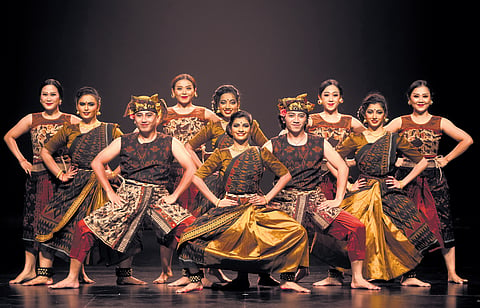
The company is the biggest Indian dance ensemble anywhere in the world. Its grand dance productions are a visual treat for the audience. They always collaborate with other Southeast Asian art forms without altering the grammar in any of them. Apart from the traditional themes that are rooted in Indian mythology, the company boldly experiments with abstract aspects of sacred (akam) as well as social (puram). ‘Arisi: Rice’, performed recently at the Music Academy in Chennai, is one such production. Aravinth keeps touring the world, and shuttles between India and Singapore. On March 2, he released his book ‘Aham: From The Creative Mind to the Stage’, in Chennai.

Talking about Apsara Dance Company’s success stories, Aravinth shares, “We believe that the dance community has to come together every year. So, we conduct the Indian Performing Arts Convention (IPAC). As many as 15 editions of IPAC, Singapore, and four editions of IPAC, Australia, have been successfully conducted. Each edition has hosted masterclasses, lecture-demonstrations, book launches, paper presentations, and performances of stalwarts. We also provide residency opportunities for young dancers and musicians encouraging them to come up with original themes.”
The influence of the Indian diaspora is not just in dance, but also in Carnatic music. Today, the biggest Indian Annual Music Festival takes place in Cleveland, Ohio, USA. In 2019, the festival was conducted in a stadium that had a footfall of 4,820 people attending; of the 350 people who sang Pancharathna Kritis on the stage, 150 flew from India just to attend the festival in Cleveland.
VV Sundaram, co-founder and secretary of the Cleveland Thyagaraja Aradhana (CTA) Committee, says, “The festival had a very modest beginning. In 1978, when the first aradhana at Cleveland was organised, there was only one concert and it was attended by only 70 people. Today the schedule and venue only keep growing each year.”
When asked about its scope and work, he says, “America is a land of opportunities that gives a lot of freedom. With so much freedom, I have witnessed closely some of them going astray into the dark, being lost. Those incidents deeply affected me. My thoughts were: How do you shepherd human-kind in a society which gives unlimited freedom? Hence, to secure the moral future of Indian children in America, we set up the cultural learning models at the temples in America.” Sundaram’s involvement in promoting Indian art began in the late 1960s and was initiated by scientist VK Vishvanathan.
Today, at a time when reality shows and digital streaming are reigning, raising funds to assemble the best of Carnatic musicians and classical dancers year after year to expose children of Indian origin to experience artistic excellence without compromising on the traditional presentation style is admirable. Through the CTA, Sundaram relentlessly continues to anchor the identity of young Indians in cultural consciousness.
The seeds that Sundaram sowed have certainly reaped benefits. With the number of children taking to Indian music and dance in that part of the world, many accompanying artistes from India fly to North America, spend a full quarter training students, giving rehearsals for their arangetram. This annual travel has done a great deal of good for the accompanying musicians, elevating their living standards.
Dance percussionist Shanmugalingam Nagarajan, who has been visiting the US and Canada since 2007, comments, “It is remarkable how the children there take to our traditions. Born and brought up in a different soil, they are blended into the cultural fabric of that land. But, they also manage to strike a balance by showing a great deal of zeal and pride to their Indian cultural heritage and identity.”
Dr Murali Parthasarathy, the vocalist for many dancers including Malavika Sarukkai and Alarmel Valli, has performed in many prestigious festivals like Jacob’s Pillow (MA, USA), Lincoln Centre (NY, USA), Musee Guimet (Paris), Théâtre de la Ville (Paris). During his interactions with TNIE, he explains with awe how Indian artistes are received outside of India, and expresses gratitude to all the artistes who have taken him to the best-performing spaces in the world. Bharatanatyam and Carnatic music are treasures that emerged from churning the Thanjavur soil. They firmly established themselves in Chennai during the post-Independent era. But, since the Indian diaspora embraced their cultural heritage, they no longer remained regional. They have rightly attained universal status, adding glory and pride to the region of its origin.
(Deepa Chakravarthy is a performing artist and practicing academic, her expertise extending from Indian art history to other traditions like yoga and vedic chanting.)