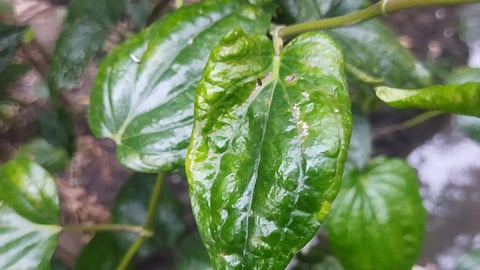

THOOTHUKUDI: The renowned ‘Authoor Vetrilai’ (betel leaves), cultivated along the banks of the Thamirabarani river in Thoothukudi district, is facing a major setback as a persistent fungal disease continues to damage the crops, causing a steep drop in the yield.
Despite the application of recommended fungicides, the infection has spread unabated, prompting farmers to demand soil testing and expert intervention from the district administration. They fear that without immediate scientific remedies, the reputation and value of the Geographical Indication (GI)-tagged Authoor betel leaves could suffer irreparable damage.
“The disease is draining nutrients from the vines, stunting their growth. Infected leaves shrink, yellow, wilt and eventually decay,” said AP Sathish Kumar, president of the Authoor Vattara Vetrilai Viyabarigal Sangam. “We have tried several fungicides and medicines, but nothing has worked. The infected leaves can’t be harvested, and the entire plant gets ruined. We are facing severe yield loss,” he added.
According to trader and farmer Murugesan, the daily harvest has dropped from an average of 4,000 kilograms to just 1,500 kilograms. He added that although minor fungal infections are typical during the windy season, the plants usually recover after rainfall- but this year’s infestation has shown no signs of retreat.
More than 300 acres are under betel vine cultivation in and around Authoor, including villages like Athiyapuram, Valavallan, Sethukuvaithan, Keeranoor, and Senthamangalam. Farmers primarily grow the ‘Pacha Karpooram’ variety, harvesting leaves every 15 days. The larger leaves, known as ‘chakka’ and the smaller ‘mathu’ are dispatched to markets across Tamil Nadu and other states including Karnataka, Maharashtra, and Rajasthan.
Despite the prestigious GI tag, the farmers claim they have received little commercial benefit due to a lack of proper guidance, marketing infrastructure and official support.
A senior horticulture official from the district acknowledged the situation, suggesting the disease may stem from nutrient deficiency. “We will soon conduct a field inspection to identify the root cause and advise farmers accordingly,” he said.
Veteran cultivators recall that betel vines once flourished in places like Eral and Mangalakurichi over a five-kilometre stretch. However, high maintenance costs, poor drainage systems, and frequent disease outbreaks have driven many farmers to switch to more viable crops such as bananas.
“Betel cultivation is becoming unsustainable for small farmers. Unless support arrives, more will abandon it, and the legacy of ‘Authoor Vetrilai’ may fade,” said Murugesan.
