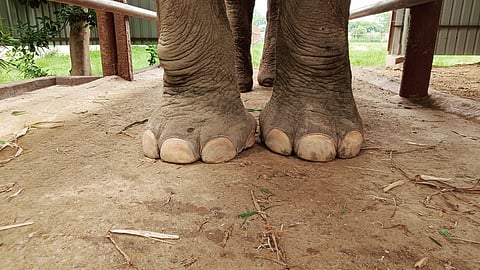

COIMBATORE: The health of captive elephants is expected to improve with the launch of new guidelines focused on foot health on Tuesday.
The guide 'Healthy Feet, Healthy Elephants' has been prepared by the Project Elephant and the Elephant Cell at the Wildlife Institute of India.
It has included recommendations from an expert committee on maintaining captive elephants in a hygienic atmosphere.
Foot problems are among the leading causes of morbidity in captive elephants. Their feet are particularly vulnerable to a range of ailments that can significantly impact their health, comfort, and longevity. Limited movement, altered foraging behaviour and exposure to artificial substrates are prime factors.
Abscesses, cracks, foot rot, arthritis, and even fatal infections are often found in captive elephants.
The guide will provide a deep understanding of the biological and anatomical basis of the elephant feet, diet, and impact of substrate on foot health.
It offers practical, hands-on instructions for foot inspection, trimming, treatment and prevention. The document also helps the budding veterinarians to do quick reference and is a training resource that encourages regular, preventive foot care.
"One of the most important aspects of an elephant is its foot. For an elephant, the foot is as important as the heart, and the new guidelines will be useful for the veterinarians, temple authorities, and private owners to take care of the animals," said Kirti Vardhan Singh, Union Minister of State for Environment, Forest, and Climate Change, who released the guide during the World Elephant Day 2025 celebration in Coimbatore on Tuesday.
Dr N Kalaivanan, Forest Veterinary Officer at the Srivilliputhur Megamalai Tiger Reserve and one of the contributors to the guide, said "In humans, cattle, and most other wild animals, the digits (fingers and toes) are separated. If one gets infected, it can affect the entire leg. But in elephants, the digits are structured together to support their massive weight. Elephants actually stand on their toes, and an average adult weighs between 4,000 and 4,500 kilograms. They also use their feet to communicate by stomping the ground, sending seismic signals that other elephants can detect up to a kilometer away. Remarkably, they can even sense seismic waves from earthquakes occurring as far as 100 km away.
"Elephant feet are uniquely structured with a natural cushion, allowing them to walk comfortably on various surfaces like rocks, soil, mud, and even swim in rivers and seas. In our forest camps at Kozhikamuthi in the Anamalai Tiger Reserve and at Theppakkadu in the Mudumalai Tiger Reserve captive elephants require minimal foot care as they are kept in a natural environment. However, elephants kept in temples or by private owners often stand for long hours on hard concrete floors. This leads to foot issues, including nerve damage and deterioration of the foot's cushion, which are difficult to treat.
"This new guide is a vital step toward preventing pain and suffering in these majestic animals," he added.
The guidelines state regular long walks on concrete or tarred road can cause serious wearing away of the foot pad, making walks on hot surface unbearable. This may lead to solar ulcer, abscess and higher incidences of nail ruptures. Also don't walk elephants on synthetic tiles, granite, mosaic and marble flooring even for short distances as they are slippery surfaces.
An elephant foot consists of skin, toenails, and a cornified but flexible sole (slipper).
Asian elephants have five toenails on each front foot and four on the rear foot.
Toenails do not bear weight, and each of it grows 0.5 to 1 cm per month.
The footpad has a fatty digital cushion that provides a good grip while walking and improves blood circulation throughout body.
