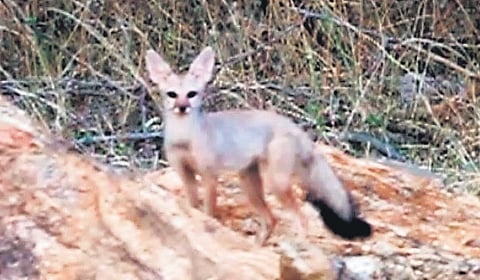

THOOTHUKUDI: The sightings of Indian fox (Vulpes bengalensis) have drastically come down in the southern districts due to various factors including habitat destruction, says a study published on August 21 in a journal ‘Mammal tales’, which evidently recorded only three sightings in the past decade.
The Indian fox, vernacularly called Kullanari, is found in the burrows across semi-arid areas, dry grasslands and scrublands in the southern districts of Thoothukudi, Tirunelveli and Tenkasi.
The species, categorised as Least Concern in IUCN Red List of Threatened Species and protected under Wildlife (Protection) Act of India 1972, plays an important role in the food chain by controlling the population of small animals, rodents and insects.
It preys on birds and small animals. Farmers noted that the population of peafowl and feral pigs might have increased due to drastic decline of foxes and jackals, adversely affecting the agriculture fields.
According to the study ‘Range reaffirmation: Indian fox sighting in eastern Tamil Nadu after four decades’, authored by Rameshwaran Mariappan, Bawa Mothilal Krishnakumar, and Mithran Maheswaran, the Indian fox population had gradually declined.
The confirmed sightings, according to the study, were on March 31, 2014 (rescue of a fox at Pidaneri village in Thoothukudi by late reptologist Naveen Joseph along with forest department personnel), on August 8, 2020 (at Krishnapuram stone quarry) and on October 5, 2020 (a fox was rescued from a well at Kettiyammalpruam village in Thoothukudi by forest officials).

Mariappan of Oorvana Palli, Centre for Reptology, told TNIE sightings of Indian foxes have become rarer than other forest species like Porcupine, hedgehog, jungle cat, palm civet, mongoose, and Pangolins.
At Nakkaneri near Radhapuram, there was a practice of hunting foxes for meat, and hanging its tail in front of the houses due to a “belief system,” he said.
“The foxes live in burrows on the outskirts of the villages and close to human settlements. However, there is no baseline data on the foxes which were once common in remote areas,” he said.
Wildlife activists, including birders who travel to deep forests, too have sighted the fox very rarely. “My last sighting was at least seven years ago — a family with two cubs — at Paruthipadu grasslands and nothing in recent times,” said Vinoba Anand, a birder, who periodically goes for nocturnal birding.
Sakthi Manickam, a wildlife photographer, said he had a glance of a fox when it ran across him at Kuthuraimozhi teri several years ago, and after that he had never seen a fox despite trekking to several forest and semi-arid regions.
Activists said expansion of agricultural area, urbanisation, deforestation, and encroachment have led to destruction of fox’s habitat. They also attributed the dwindling number of the species to poaching and unavailability of prey.
A senior forest officer told TNIE the decline of foxes has resulted in an increase in peafowl population, which is detrimental for agriculture. Similarly, the number of feral pig too has gone up due to prey-predator imbalance, he said.
Alongside awareness campaigns of fox conservation, the state government has initiated ‘Fox Distribution Survey’ online on behalf of the Advanced institute for wildlife conservation, he added.