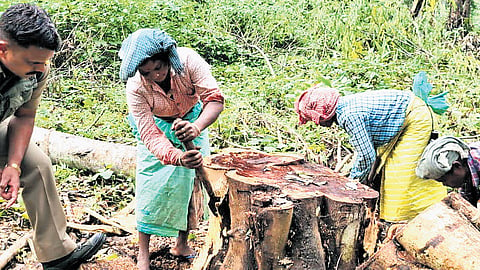

CHENNAI: The Tamil Nadu Forest Department has set an ambitious target to eradicate Senna spectabilis from all forest divisions by March 2026, marking one of India’s largest state-led invasive species removal drives. Official data show the yellow-flowering invasive has spread across 2,446 hectares, of which 1,963 hectares have already been cleared, leaving 483 hectares to be tackled in the next phase.
Senna spectabilis, which has overrun forest floors in the Nilgiris, Mudumalai and Sathyamangalam, is among the most disruptive invasives in the Western Ghats. Its dense monoculture suppresses native understorey vegetation, intensifies forest fire risk, and reduces fodder for herbivores including elephants and deer.
However, Senna is just one part of Tamil Nadu’s larger ecological challenge. Forests in the state host 1,77,363 hectares of invasive plant species. Of this, only 34,710 hectares have been cleared so far, leaving 1,42,653 hectares awaiting restoration. The most widespread intruders are Lantana camara (1,44,034 ha), Prosopis juliflora (23,454 ha) and wattle (7,429 ha). So far, the state has removed 26,735 ha of lantana, 4,685 ha of Prosopis, and 1,327 ha of wattle.
Supriya Sahu, Additional Chief Secretary, Environment, Forest and Climate Change Department, told TNIE that the 2023 IPBES report underscores the urgency, warning that invasive alien species are among the top five direct drivers of global biodiversity loss, with an annual economic cost exceeding $423 billion.
“Time is running out, and the message is clear: governments must act with urgency and scale. Tamil Nadu recognised this challenge early and moved from policy to practice. Through India’s first State Policy for Invasive Plant Eradication and Restoration (PIPER), launched by Chief Minister M K Stalin, we are clearing Senna, Prosopis and lantana across thousands of hectares and restoring native habitats. Removed Senna is also being converted into eco-friendly paper pulp through TNPL, proving that restoration and circular economy can go hand in hand,” she said.
To fast-track removal, the state partnered with Tamil Nadu Newsprint and Papers Limited (TNPL) and Seshasayee Paper and Boards Limited (SPB), which extract Senna biomass and convert it into pulpwood. TNPL has lifted 31,258 metric tonnes of Senna from 854 hectares, completing removal in Mudumalai Tiger Reserve (485 ha), Sathyamangalam Tiger Reserve (239 ha) and Dindigul (80 ha), while SPB cleared 340.12 hectares across Pollachi, Erode, Sathyamangalam, Udhagai and Masinagudi.
Forest managers caution that eradication requires long-term upkeep. Mudumalai Tiger Reserve Field Director R Kiruba Shankar said fresh shoots continue to appear after clearing. “We need to maintain the landscape for at least two to three years to effect permanent change. New Senna shoots emerge from deep roots. Maintenance is key.”
Officials note that once Senna is eliminated by March 2026, focus will shift to ecological restoration using native grasses and shrubs, particularly in elephant and tiger habitats heavily altered by invasives.
